By JULIE CARLE
BG Independent News
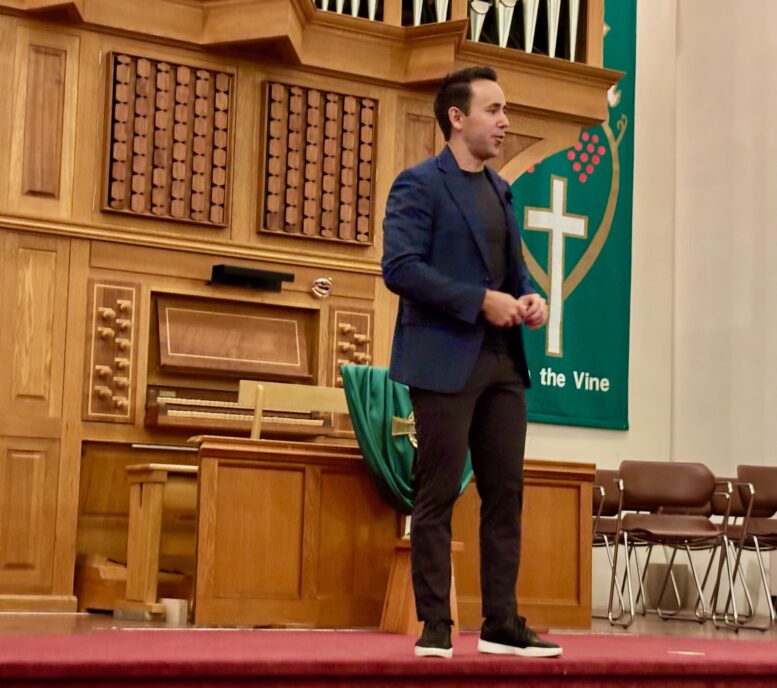
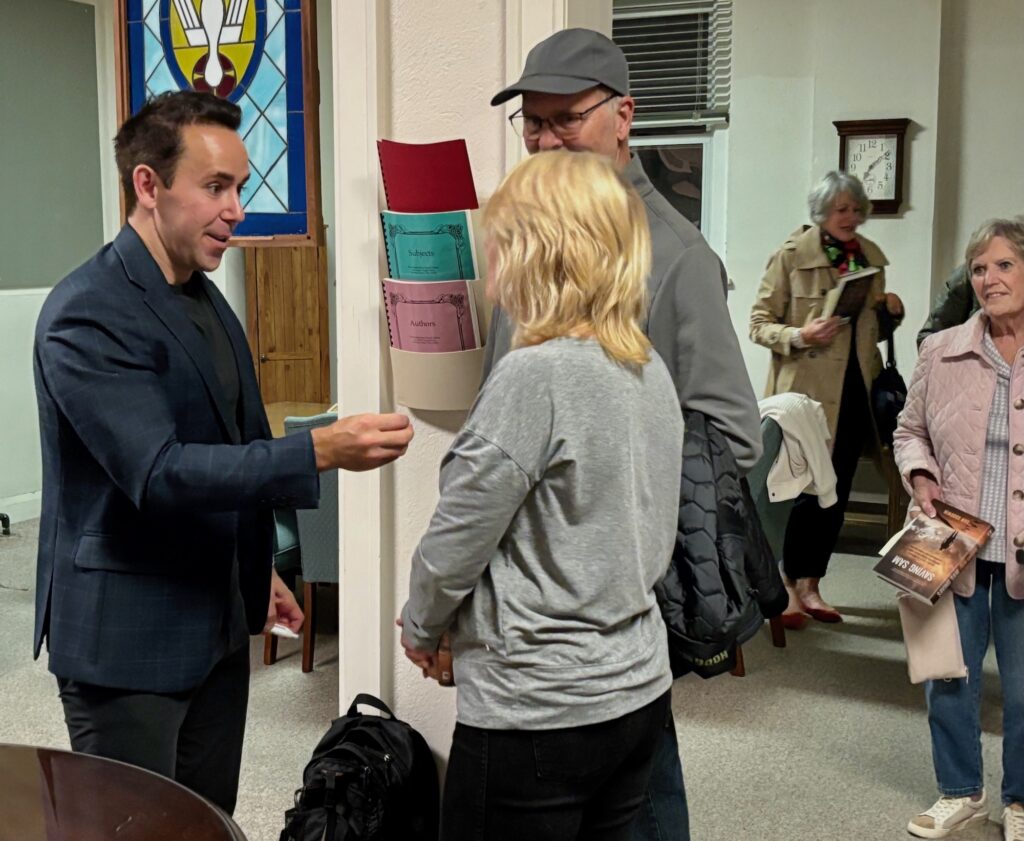
“Uncertainty is a horrible thing. It’s a waste,” Sam Goodwin said Wednesday night to a standing-room-only crowd eager to hear his Wood County District Public Library Foundation Series talk.
The author, former Wood County resident, entrepreneur, athlete, world traveler, and Syrian hostage for 62 days relayed a synopsis of his best-selling book “Saving Sam,” about his life-changing hostage ordeal. But the heart of his powerful, emotional message was more a life lesson of sameness—how being held captive in an 8x 8 Syrian cell maybe isn’t all that different from the everyday challenges people face in their lives.
The struggles of feeling overwhelmed or underappreciated, not being heard or having “your very baseline values challenged,” can benefit from some of the same strengths he relied on when he was uncertain if he would live or die in that Syrian prison cell.
He conveyed some of the angst and overwhelm he experienced in the cell, by walking four paces before hitting a wall, turning around and walking four paces in the other direction before hitting a wall. He described the stench that wafted from the hole in the corner that served as his toilet. As the audience watched and listened, he made the uncertainty and fear that he felt stuck for two months in the unknown palpable.
His goal was to convince everyone that regardless of the challenges faced, achieving success is determined by the response to the challenges. “If you’re going to succeed, it has to be the same recipe I used over there just to survive,” Goodwin said.
To understand how he made it through, it’s important to know a little more of his story
If you haven’t read the book
“Saving Sam: The True Story of an American’s Disappearance in Syria and His Family’s Extraordinary Fight to Bring Him Home” details Sam Goodwin ’s horrific but life-changing experience as a hostage in a Syrian prison and his family’s fight to get him home safely.
He was born in Wood County and learned to skate at the BG Ice Arena now the Slater Family Ice Arena. His father, Thomas A. Goodwin, TAG, grew up in Bowling Green and was a 1974 graduate of Bowling Green High School. Though Sam’s family moved to St. Louis, Missouri, in 2001, he still has lots of family in the area, including his grandmother, Elaine Goodwin.
His compelling story and the Bowling Green family connection contributed to the demand for tickets that eventually led to his talk being moved from the library’s atrium to the more expansive space of the First Presbyterian Church.
He attended Niagara University for his undergraduate degree and where he played Division I hockey.
After graduating in 2012, he was offered his first professional job in Singapore with a tech startup. Uncertain about the opportunity, he talked to his father. “My dad said, ‘Sam, just go. The worst thing that happens is you come home, and you can always do that,’” Goodwin recalled. “That was how my parents viewed a situation like that. I view that moment as like the foundation of my adulthood. I’m really grateful for that perspective.”
The job that was supposed to be three months turned into six years. In those six years, Goodwin traveled extensively, never to the same location, because “travel is the best education,” he said.
By early 2018, he had traveled to 120 countries in the world. When he learned there are 193 fully recognized sovereign states in the world, he set a personal goal to visit all 193. “I became committed to working toward achieving something that I thought was extraordinary,” he said.
A year later in the spring of 2019, he had traveled to 180 countries. His next destination was Syria. Despite the country experiencing “arguably the most tragic humanitarian disaster of our lifetime,” Goodwin believed some of the places that are negatively perceived “were the same places where I had many of my best experiences, where my perspectives were most meaningfully impacted.” He was confident that would be the same in Syria when he arrived on May 25, 2019.
That was not the case.
Within two hours of arriving in the northeast region of Syria, he was walking to meet his guide when a black pickup truck pulled up, two men jumped out and ordered him to get inside. They weren’t violent, but they were skeptical about his travel history and motives. They accused him of being an American spy and collaborating with terrorists.
Goodwin admitted being scared and confused, with no information or anyone to help him. He was taken to Damascus, where he was thrown into the basement of Syria’s Military Intelligence Prison Number 215, known for housing political prisoners.
Once inside the 8×8 solitary confinement cell, Goodwin was stunned and in disbelief, as he realized his “life had spiraled out of control in the most terrifying of ways.”
For 27 days, he was in solitary confinement, and twice a day he was given bread, boiled potatoes and water. He wasn’t tortured, but hearing other prisoners being tortured and beaten, he wondered when it was his turn.
“I realized I was in an environment where nothing was off limits. I never stopped caring about dying or the long list of other bad things I thought might happen, but I began to lose the energy to be afraid,” he said. “Average prisoners spend their time counting down the days to the end of their sentence, but hostages count up during this time in that cell.”
He counted 62 days before he was freed thanks to the secretive, brave, behind-the-scenes work of his family and an amazing network of friends, government insiders and others.
Recipe for success in trying times
After several days of pacing back and forth in the prison cell, Goodwin stopped and thought, “Maybe there is some good in this situation.”
Though his inner voice said, “Sam, are you crazy? You’ve just been taken hostage. There’s nothing good here.”
He fought that inner voice and realized he was grateful to be alive, for his health, education and for the food and water he was being given. Those small expressions of gratitude “became this silent rebellion against the uncertainty of the situation,” the first step toward strength that he took in place of the early pacing steps he took in fear and confusion.
Once he leaned into gratitude, he knew just sitting around in that tiny, sparse space was not helpful. He chose to take action and control what he could control.
Admittedly, that mindset was “a bit counterintuitive, because solitary confinement, by definition, means no action, and there’s no movement. It’s isolation,” Goodwin explained.
Most things were out of his control. But he could control his thoughts, attitudes, prayers and exercise. He did pushups, sit-ups, core exercises and controlled his routine within the cell.
He knew it was unrealistic to get rid of all the negative thoughts and feelings, but his goal “was to change the way I responded to them.”
As time went on, Goodwin noticed “a strange transformative perspective began to emerge.” Despite being in the most unimaginable situation, he began to beliee that if he could maintain hope,persevere and survive, he would be better equipped to take on more challenges in his life.
In the years leading up to the hostage situation, he had grown a lot, from moving to Asia, helping start a tech company, and traveling the world.
In that cell, he felt stuck, until he realized “this is when I was growing the most.” He understood his third actionable item was “to recognize uncertainty as an opportunity.”
Those three initiatives helped him make it to Day 27 when he was moved from solitary confinement to Adra Prison, Syria’s central federal prison, and put in a cell with 40 other men.
He remained there for 35 days during which time he was in court four times. The judge, lawyer and translator denied him getting a fair trial.
“The whole process was taking place inside this ideological vacuum and was not going to be impacted by anything I said or did,” Goodwin said.
However, back in the prison, the other inmates befriended him. They cooked and shared food. They taught him Arabic and he taught them English. One of the inmates smuggled a note out of prison on his behalf—“a note that successfully navigated the game of geopolitical telephone and made it to my father in St. Louis, serving as the first time I managed to communicate that I was alive,” he said. “These men truly risked their lives to help save mine. It was a remarkable display of humanity.”
He learned the men in the prison with him were victims of a corrupt system. The time he spent with them in prison taught him to “never judge people by the actions of their government” and that “people who have the least often give the most. Every person’s why is the same: We all eat, sleep, breathe and want to be happier chasing some kind of goal. It’s only the how that changes.”
On July 26, 2019, his name was called and told he was being moved because President Bashar al-Assad had agreed to release him. “I had been lied to so many times in the past two months that I became immune to believing anything like this,” he said.
After being raced out of Damascus in a five-vehicle convoy, they passed a checkpoint, and the officer in the vehicle said, “Sam, you’re in Lebanon. You’re safe.”
He was taken into the Lebanese internal security office, where he was greeted by dozens of government and military intelligence officials, journalists, Major General Abbas Ibrahaim, who helped mediate his release, and, most importantly, his parents. That is where he learned their side of the story and all that had transpired to get him to safety.
“It was an indescribably emotional moment and one that many people thought would never happen,” he said. He became the only American civilian that Assad ever released.
He has learned “to survive survival,” and on Dec. 31, 2019, he traveled to Brazil to reach his goal of visiting every country in the world.
The book captures the details and nuances of the entire ordeal from perspectives beyond Goodwin’s.
Click here to read the BG Independent News story written about the book after it was published in 2024, or even better, read the book for the entire story. Visit the library to borrow the book or purchase it at a bookstore of choice.
“The best thing I can offer is an interesting hostage story,” he said. But the three universal actions to realize success—gratitude, controlling what you can control, and seeing challenges as opportunities–are “why I think your life and mine intersected here tonight in Bowling Green.”