(Editor’s note: Story has been updated to include information from Williams pipeline company.)
By JAN McLAUGHLIN
BG Independent News
The Luidhardt family has been farming much of the same land for longer than Jon Luidhardt can recall.
Then along came Will-Power with a sweet offer to buy some of the family’s acreage north of Bowling Green to use for a natural gas pipeline to power the Meta data center being built in Middleton Township.
The Luidhardt family said “no.”
“It’s land that’s been in my family for at least three generations,” Luidhardt said. “We want to continue a fourth and fifth generation of farming.” So the family filed a lawsuit fighting possible eminent domain action from Williams, the pipeline company.
Alex Schott, director of strategic communications with Williams, said the Luidhardt property was not on the final route selected by the pipeline company. Schott also said Williams did not threaten or pursue eminent domain on this pipeline route to serve the Meta data center in Middleton Township.
“We already had 100% acquisition before this farmer filed an intervention, and the Luidhart property was not on the pipeline route submitted for review,” Schott wrote in an email.
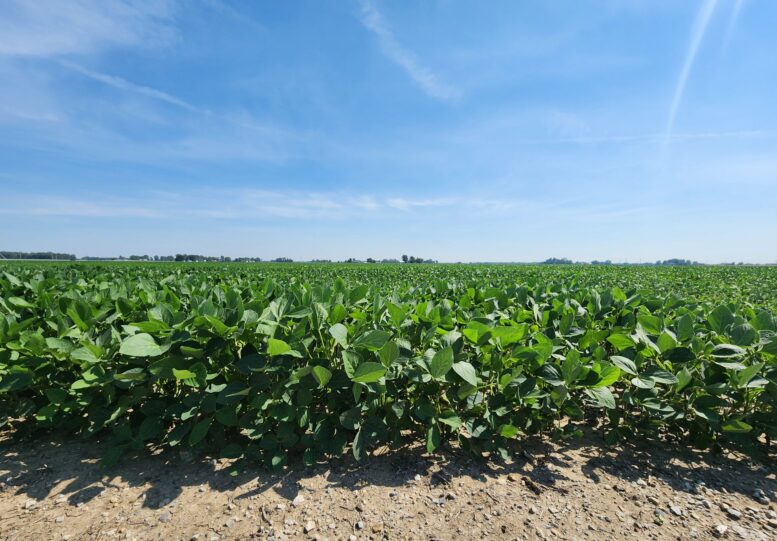
But Jon Luidhardt said he had been presented with a map that showed the pipeline going through his family’s soybean field between Bowling Green and Haskins, So Luidhardt and his father, Ken, reached out to attorney Maurice Thompson, executive director of the 1851 Center for Constitutional Law in Columbus. The family had worked with Thompson before to successfully stop another pipeline from crossing their land.
Thompson, who comes from a long line of Wood County farmers, intervened with the Ohio Power Siting Board to stop the new pipeline from slicing through the Luidhardt’s 40 acres near the corner of Haskins Road and Hannah Road.
In his motion to intervene, Thompson contended that Ohioans’ private property cannot be taken simply to benefit purely private corporate projects, which includes the private pipelines fueling those projects alone.
“They finally had someone stand up to them,” Jon Luidhardt said.
It is understandable how some landowners buckle to the offer of big bucks for their land.
“They offer an insane amount of money and a lot of people have sold out,” Luidhardt said, noting that some offers are as much as $200,000 an acre.
“Money isn’t an object to them, and they don’t care about family history,” he said about Meta and pipeline companies.
Last fall, owners of farm acreage south of Bowling Green reported that representatives of a natural gas pipeline were making inquiries about installing a line to the Meta site. One of the landowners said the firm working on behalf of the pipeline business, Williams Companies, was contacting descendants of the property owners to make them aware of the potential income from a pipeline.
Meta and its pipeline affiliate are free to purchase any land from those willing to voluntarily sell. But Thompson stressed that in the case of the Apollo pipeline, the only entity being served will be Meta.
“The project is solely to fuel a single private business, rather than to heat Ohioans’ homes or fuel their cars,” Thompson wrote.
“This power plant is to power Meta,” Luidhardt said. “If this was powering neighborhoods, we wouldn’t stand a chance.”
The fact that the Apollo power plant, located to the east of the data center, will serve just Meta worked in its favor to get approval from the Ohio Power Siting Board with no public hearings being held.
In February, the state board fast tracked the plant approval since it will operate “behind-the-meter” to serve just the electric demands of the adjacent data center and will not be physically connected to the electric power grid.
Matt Butler, the public information officer for the Ohio Power Siting Board, said in February that the permit process went through the PUCO’s “expedited review process” intended for power plants dedicated to a single customer and sited on industrial property.
But the taking of private land for such a project does not sit well with Thompson, who used the issue as a forum to protest eminent domain efforts – even though eminent domain was not being used to gain property for this pipeline route.
“This is redistribution of wealth of the worst sort – taking property from regular Ohioans and giving it to California billionaires for their own benefit, under the false pretense of progress,” Thompson continued. “The State and Meta are seeking to use force rather than persuasion to decide the debate on whether trading longstanding farmland for data centers is a wise investment. We, like this state’s founders, prefer a state where property owners retain dominion over their property, and private industry stands on its own feet, without special handouts or privileges coming at the expense of others.”