
By JAN McLAUGHLIN
BG Independent News
Now might be a good time to touch up that peeling paint, tuckpoint that chimney, and firm up that sagging front porch.
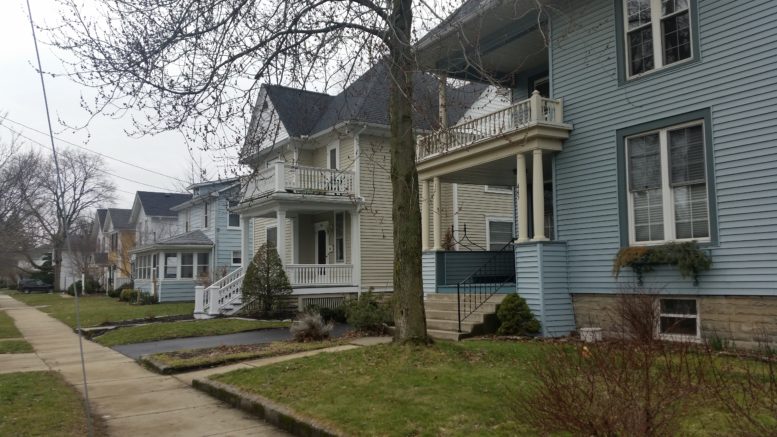
Starting this month through September, a sanitarian from the Wood County Health Department will be walking the neighborhoods of Bowling Green, surveying the exterior condition of more than 6,000 homes.
The exterior surveys are conducted every five years since 1988.
The housing checks are intended to give city leaders a birds-eye view of housing conditions in Bowling Green, according to City Planning Director Heather Sayler.
“The Exterior Housing Evaluation Survey is a proactive means to gauge data on the condition of existing housing, where improvements have occurred or may be needed, and if any changes may be needed to align the city’s housing programs with existing needs,” Sayler said.
In 2021, the housing surveys showed the most common problems included junk outside homes, accessory structure issues, problem soffits, poor siding, cracked chimneys, broken public sidewalks and sagging porches.
The goal of the housing program is to protect occupants and the public from unsafe and unhealthy housing situations and to preserve the existing housing stock.
A contract with the city of Bowling Green has allowed the health department to conduct its exterior housing inspection program in the city. The data gathering survey is used by the health department to identify neighborhoods that have problems with exterior housing structure, maintenance and sanitation.
Once problems are identified, the health department starts with a written notice of violation. In extreme situations, the cases are sent to the county prosecutor. In some cases, homeowners are connected with assistance through Community Housing Improvement Plan grants or Adult Protective Services.
The city will also offer help to those who qualify.
Each home is surveyed in 14 primary and 10 non-primary categories.
The primary categories are roofs, siding condition, stairs and railings, windows, foundations, off-street parking, public walks, chimneys, porches, doors, accessory structures, soffits and roof edges, private walks and exterior sanitation.
The non-primary categories are paint, gutters/downspouts, attached garage, garage condition, grading/drainage, dumpsters, yard maintenance, starlings and pigeons, siding type and address present.
Homes that are substandard in two or three primary categories are classified as “deficient.” Homes that are substandard in four or more primary categories are classified as “neglected.”
During the last survey, the results included:
- 5,875 total homes surveyed.
- 366 total primary deficiencies.
- 129 deficient homes.
- 5 neglected homes.
- 5,290 homes with no deficiencies.
The 2021 results compared with results in 2016 found:
- Total primary deficiencies decreased from 795 to 366.
- The number of properties with primary deficiencies decreased from 627 to 307.
- Properties with zero deficiencies increased from 4,919 to 5,570.
- Total homes surveyed increased from 5,546 to 5,875.
- Total deficient homes decreased from 130 to 129.
- Total neglected homes decreased from 7 to 5.
The 2021 results were divided into the four wards in the city. The total of 366 deficiencies were found:
- First Ward had 94 out of 478 homes surveyed.
- Second Ward had 143 out of 1,005 homes.
- Third Ward had 58 out of 1,621 homes.
- Fourth Ward had 71 out of 2,771 homes.
The seven highest areas of deficiencies were:
- 110 exterior sanitation (30.1%)
- 49 accessory structures (13.4%)
- 42 soffits (11.5%)
- 40 siding condition (10.9%)
- 35 chimneys (9.6%)
- 30 public walks (8.2%)
- 24 porches (6.6%)
The exterior housing survey is a unique arrangement between the city and county health department. In most cases, health departments respond on a complaint basis – putting fires out as they occur. But in Bowling Green, the city tries to keep those fires from ever starting by having the surveys done every five years.
So for the next few months, a sanitarian from the health department will be viewing the exterior of one and two-unit dwellings and accessory structures from the public right-of-way. They will survey the homes from public sidewalks and streets, and will be wearing appropriate identification as they walk through each neighborhood, taking notes with an electronic device.
The first EHES was completed in 1988 and occurs every five years. Past surveys can be viewed on the city’s website at bgohio.gov/278/Health-Safety-or-Sanitation-Concerns.
In 1973, the Wood County Health Department adopted a housing code, making revisions to the code in 1976. The purpose of the code was to allow the health department to inspect homes and correct unhealthy, unsafe, and deteriorating housing structures. The goal of the health department housing program is to protect occupants and the public from unsafe and unhealthy housing situations and to preserve the existing housing stock.
In 1986, the “Wood County Health, Safety and Sanitation Regulations for Structures and Vacant Lots” superseded the housing code. This code incorporated the previous housing code but expanded the ability of the health department to deal with unsafe, unhealthy or deteriorating situations in all structures and vacant lots. The health department’s structure code has since been revised in 1988, 1995, 2000, 2004 and 2005.
Anyone seeking more information may contact the Wood County Health Department at 419-352-8402 ext. 3298 or the City of Bowling Green Planning Department at 419-354-6218 with any questions.
