By JAN McLAUGHLIN
BG Independent News
Providing decent affordable housing in Wood County took a hit from the Covid pandemic that Habitat for Humanity is still recovering from.
The lingering effects of the pandemic, combined current economic strain, have led to increasing building supply costs, fewer corporate donations of dollars and volunteer help, and higher costs of purchasing property for homes.
To get Habitat for Humanity of Wood County through the tough post-Covid period, the Wood County Commissioners had allocated $400,000 in American Rescue Plan Act funds to the local Habitat efforts.
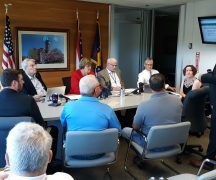
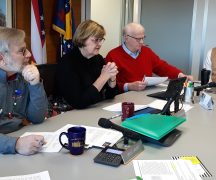
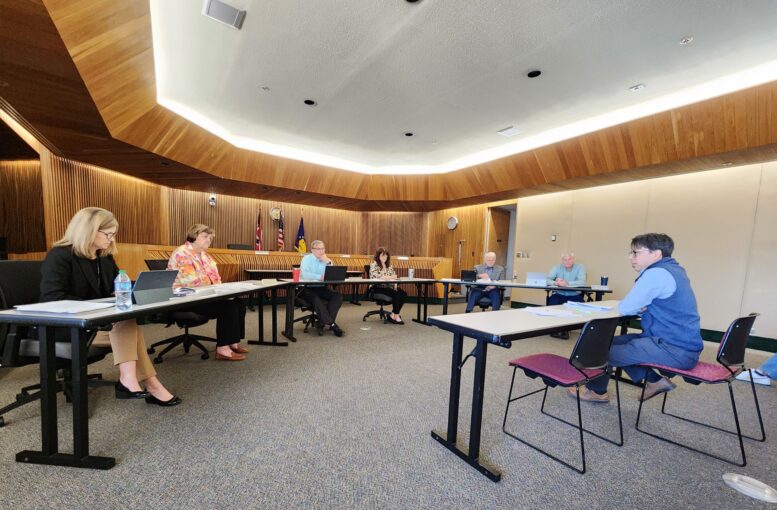
Last week, Habitat Executive Director Mark Ohashi reported to the commissioners on how that money was put to use.
In total, the funding helped build 12 new homes in Wood County, in the communities of Bradner, Wayne, Grand Rapids, Weston, Walbridge, Rossford and Northwood. ARPA funds of $226,000 covered 21% of project expenses from 2022-2025, which totaled over $1 million, not including donated materials and labor.
“As we experienced a reduction in corporate financial support over these years, the support was essential in allowing us to cover our costs,” Ohashi reported.
“We are beginning to see some re-engagement from the corporate sector in the form of both volunteer and financial support,” he added. “This will be essential in not just maintaining our current rate of construction but also increasing this number of projects completed.”
Ohashi also pointed out that while Habitat used to purchase land at approximately $7,500 to $8,000 per building lot, the cost has increased to $15,000 per lot, and even up to $25,000 per lot in rural areas of Wood County outside of Bowling Green.
The other $174,000 in ARPA funds were used to support 36% of staff costs for the positions of homeowner services coordinator, volunteer coordinator, and construction manager from 2022-2025.
The homeowner services coordinator position assists Habitat applicants, and supports them through construction of the home, and communication about closings and beyond. All families must go through homeowner education and financial education.
The volunteer coordinator manages the workforce that builds homes. Recruitment and coordination of volunteers ensure that every project is built safely on schedule, and is a positive experience so volunteers are likely to return on future builds. In 2025, a total of 509 volunteers donated 6,762 hours to Habitat, Ohashi said.
Ohashi expressed his thanks to the county commissioners for their support with the ARPA funds.
“That had a huge impact allowing us to keep moving post Covid,” he said. “It’s greatly appreciated that you chose to support our program.”
Commissioner Doris Herringshaw said the funding was put to good use.
“You used our money wisely,” she said to Ohashi.
With volatility remaining in the market, Habitat is working to diversify its revenue streams, Ohashi said.
“For that reason, Habitat launched its own ReStore in 2025, to build financial self-sustainability, with the expectation that profits will grow to support an increase in production and ultimately to serve more families in Wood County with affordable homeownership and needed home repairs,” he said.
At the same time, Habitat continues to work with landowners in Wood County to secure land for building homes, Ohashi said.
“That’s going to be the next big factor moving us forward.”
“We believe that this is paramount to continuing the mission of providing affordable housing opportunities to families in Wood County,” he said.
Ohashi reported to the commissioners that Habitat will soon be building new homes in Bradner, Tontogany and North Baltimore, as needs continue.
“Unfortunately that’s a serious need,” he said.
Following are brief descriptions of the 12 families who were selected and put sweat equity into Habitat homes between 2022 and 2025:
- A mother of four, who manages sales at a local furniture retailer and takes on-call shifts at a behavioral health center, lived in a rental home which was becoming increasingly unaffordable, in an area where she no longer felt safe. Her car was broken into three times, and a shooting at a park one block away left her shaken. The family now lives in a Habitat home in Rossford.
- Three generations of one family are now living together in a decent Habitat home in Weston. Previously, the grandmother lived in a manufactured home with floors that were soft and uneven, a leaking roof, and unsafe porch. The mother and her two children lived in a rental home in an area not suitable for children.
- A single mother with five children, ages 8 to 15, previously lived in substandard housing with unsafe conditions, at times without power, heat or water. The mother turned their lives around by reaching out for help with housing and for domestic violence. They now live in a Habitat home in Wayne.
- A couple and their four children lived in a deteriorating trailer in need of many repairs. They faced high costs of living, car struggles, and difficulty getting approved for a home loan. Now they live in a structurally safe Habitat home in a quiet neighborhood in Wayne, with a safe place for the children to play.
- A single father of two children, one with autism, was living in his parents’ home until he could find affordable housing. He found the answer with a Habitat home in Grand Rapids.
- A single mother of two teenagers struggled to find affordable housing, despite having three jobs. The family was living in an apartment where the mother slept on the couch. They found a decent and affordable home through Habitat in Northwood.
- A family of four, with a single mother, was living in an 811-square foot rental. Though the mother has a good job as a union painter, she still had difficulty finding an affordable home that didn’t need extensive repairs. They now live in a Rossford Habitat home.
- A single mother, with two children, was living in a camper at one point due to the end of a marriage and the sky-high cost of rent. The family now lives in a Habitat home in Weston.
- A couple with three teenage children had their world turned upside down when the mom’s cancer diagnosis forced her to leave her job, plunging the family into financial instability. They were temporarily homeless before they found a dilapidated rental home with moldy walls, a leaking foundation and a single closet for five people. The family now has a Habitat home in Wayne.
- A mom and her daughter lived for years in a rental with limited space in a high-crime area of Toledo. An employee of the Home Depot distribution center in Wood County, the mom applied for a Habitat home and now lives in one in Bradner.
- A mom and her two children were sharing one bedroom in a family member’s home, when she applied for a Habitat home. The family now lives in Bradner, where the children can stay in their school.
- A couple and their daughter, originally from Toledo, left behind a neighborhood with frequent gunfire and a landlord who refused to address critical repairs to their apartment. Seeking safety and stability, the family moved four times in five years due to rising rent prices. Both parents work, but could not find housing they could afford – until Habitat. They now live in Walbridge.