On its 100th birthday, the Cla-Zel Theater in downtown Bowling Green is getting a sequel run as the community’s Historic Building of the Month.
In August 2023, the Bowling Green Historic Preservation Commission featured the Cla-Zel Theater (1926) as its Historic Building of the Month. The Cla-Zel is being featured once again, to celebrate its 100th birthday and its new incarnation as an entertainment venue featuring music, film, and community events.
(Jan Knape, a member of the friends of the commission, wrote the original article, and Geoff Howes, a member of the commission, has updated it.)
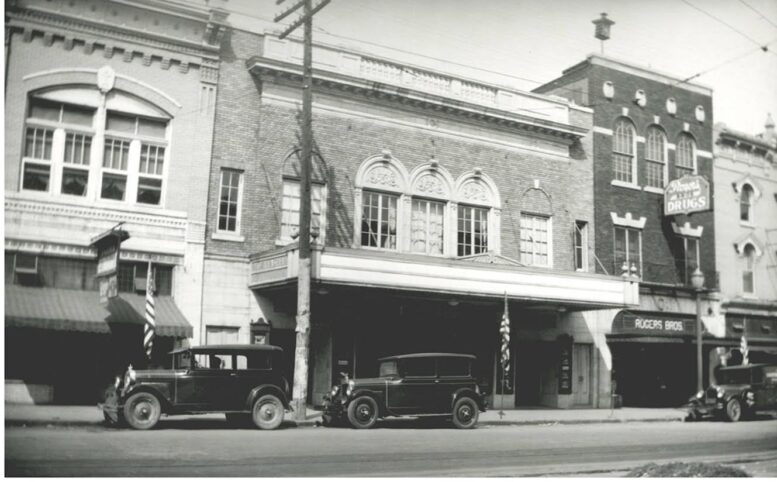
From its opening date in 1926 the Cla-Zel Theater was in continuous operation as a single screen movie house, the oldest in Ohio, until 2004. This iconic building of the 20th century in Bowling Green still features the original marquee and has provided an entertainment venue at 127 N. Main St. for 100 years.
The Classical Revival theater was designed by architect Jack Raney and built in 1926 for Clark and Hazel Young, replacing an earlier open-air theater at the same location. In the era of silent films, the Cla-Zel was built by S.P. Stewart and Son for $150,000. The fire-proof building was uniquely named for the new owners, Clark and Hazel Young, in a contest.
Across the street was the original Lyric Theater (122-124 N. Main St.) built in 1900, one of several theaters in the same block, including The Peoples’ (156 N. Main St. until 1918), and the Everybody’s (114 N. Main St. until 1922). The Del-Mar (originally the Hankey-Taber Opera House, built in 1889, then renamed The Chidester) was located at 165-169 S. Main St. – now a parking lot. The Del-Mar was destroyed by fire on Sept. 29, 1926, shortly after the Cla-Zel opened.
Clark Young had experience operating most of these theaters alone until 1916, when he married Hazel Keeler of Haskins. These other theater venues hosted live companies of vaudeville entertainers, Charleston dance contests, and famous actors in plays. Admissions for these shows at the time ranged from 15 to 35 cents.
When the Cla-Zel opened for movies to a capacity crowd on April 21, 1926, ticket prices were 5 and 10 cents, with 5 cent matinees on Saturday. The children of the Children’s Home on West Wooster Street were admitted for free, much to their delight.
The Cla-Zel housed a large Marr and Colton theater pipe organ built in Warsaw, New York, to accompany the moving pictures. These silent films were called “one reelers,” lasting about 15 minutes.
Then the operator would change the reel, while merchant advertising slides were shown, or instructions such as “Ladies Remove Your Hats,” “No Smoking,” or “One Moment Please” graced the screen. Finally, after 10 or more minutes, the next reel would be ready to go.
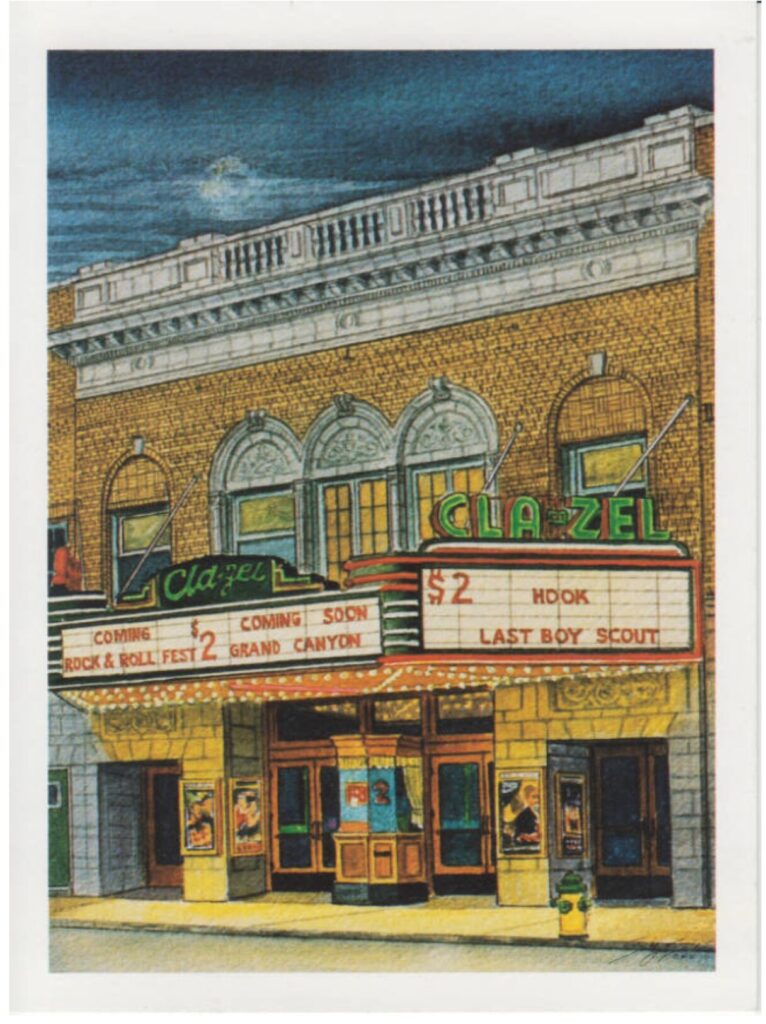
In February of 1930, the Cla-Zel installed a new Western Electric sound system, and only talking pictures were screened thereafter. Because the first “talkies” were recorded on discs, an attachment was placed on the projector, and the sound was wired to speakers behind the movie screen. Often, the sound and pictures were not in sync, contributing to amusement, confusion, and in many cases, frustration.
Later, the soundtrack was added to the edge of the film, keeping the sound and action in sync with Vitaphone and Movietone, “the world’s best in reproduction systems.”
Clark and Hazel operated the Cla-Zel until 1940, when the building was leased to Schine Theaters. However, this lease was canceled by order of the Federal Court due to a violation of a previous order by Schine. The lease was reassigned to Carl Schwyn of Cygnet and was co-operated with Jack Armstrong for several years.
Armstrong bought out Schwyn’s interest and organized the Armstrong Theater Circuit. In 1960, he purchased the Cla-Zel Theater, and also the Portage Drive-In. Cinema 1 and 2 opened in the Stadium Plaza in 1970 on East Wooster Street, now renamed the Greenwood Centre.
Until the late 1990s, “The Rocky Horror Picture Show” was screened every Thursday night. Starting in 2000, the theater was operated as a non-profit with a governing board. It ran both first-run movies like “Legally Blonde” or “O Brother Where Art Thou” and classics like “The Wizard of Oz” and “Casablanca.”
But viewership declined and the theater lost money. On May 7, 2005, “Popeye,” “Our Gang,” and “Roy Rogers” closed out the Cla-Zel’s existence as a movie house. “Rocky Horror,” a midnight feature, was the last film shown.
In 2008, the Cla-Zel was purchased and remodeled with a full bar and dance floor, as a nightclub and special event venue. Ammar Mufleh oversaw the restoration of the Cla-Zel’s well-known marquee and the refinishing of its original wood ticket booth and glass-paneled lobby doors. Inside, decorative plaster molding on the ceiling has been replicated, and a stairway ascends to the balcony. Six original chandeliers, rumored to be Tiffany, hang gracefully from the ceiling.
The stage and screen were still front and center, along with a collection of film reels, dating back to Charlie Chaplin films. The ticket window was also operable, outside of the beautiful lobby area.
For decades, BGSU students were regular visitors to the Cla-Zel and have fond memories of the local theater and club experience. Jan Knape fondly remembers standing in line with her daughters with much anticipation to see the first release of “Titanic” in December 1997.
In the original 2023 article, Knape expressed her wish that the Cla-Zel could continue to be an important historic building in the downtown, where many have had fond memories, whether it be watching an old movie, listening to musicians, or attending a special event.
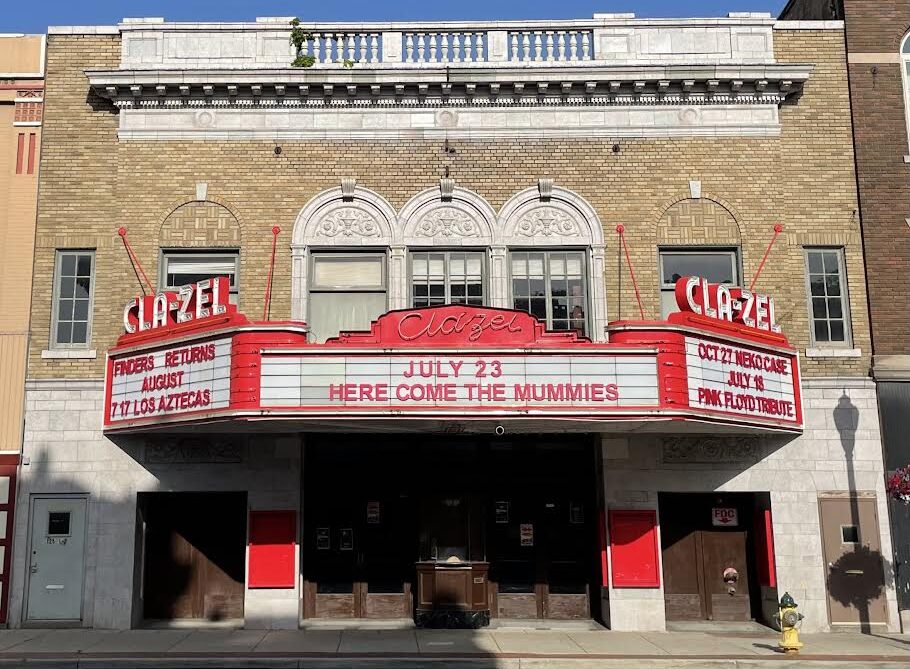
In 2025, Broc Curry started to make that wish come true. He bought the Cla-Zel business, and he and the building owner Ammar Mufleh have worked to preserve the historic building and turn it into an entertainment venue for music, movies, and community events.
Curry grew up in Bowling Green, and at a young age he was already booking bands at local bars and, of course, watching movies with friends at the Cla-Zel. He also owns and operates the music clubs Frankie’s and the Ottawa Tavern in Toledo and is preparing to reopen the legendary Finders Records store across Main Street from the Cla-Zel, another contribution to local preservation.
The building he took on was “decrepit at best. But it was a cool theater with really cool bones.” The structure itself was sound: “It’s built like a bunker.” So, he and his crew spruced up the iconic neon marquee and touched up the paint and woodwork at the theater’s entrance.
The Cla-Zel fills a gap in the Toledo area concert scene between small venues like Frankie’s and big ones like the Stranahan Theater. The grand opening was on Oct. 24, 2025, with the headliners Equipment, an emo/pop punk band from Toledo.
Since then, this venerable piece of Bowling Green history has hosted a number of tribute acts and other concerts. Among the future bookings are more tribute bands, a celebration of Tejano and Conjunto music, a night of emo karaoke, and the nationally known original acts Here Come the Mummies and Neko Case.
Bowling Green is lucky to have a century-old landmark that has been preserved while being brought up to date to entertain contemporary audiences.
Would you like to nominate a historic building or site for recognition? You can do this through the City website at – https://www.bgohio.org/FormCenter/Planning-13/Historic-BuildingSite-Nomination-Form-83
You can learn more about the Historic Preservation Commission by attending their meetings (the fourth Tuesday of each month at 4 p.m.) or by visiting their webpage at – https://www.bgohio.org/436/Historic-Preservation-Commission.