
By ANDREW SPIESS
BG Independent News
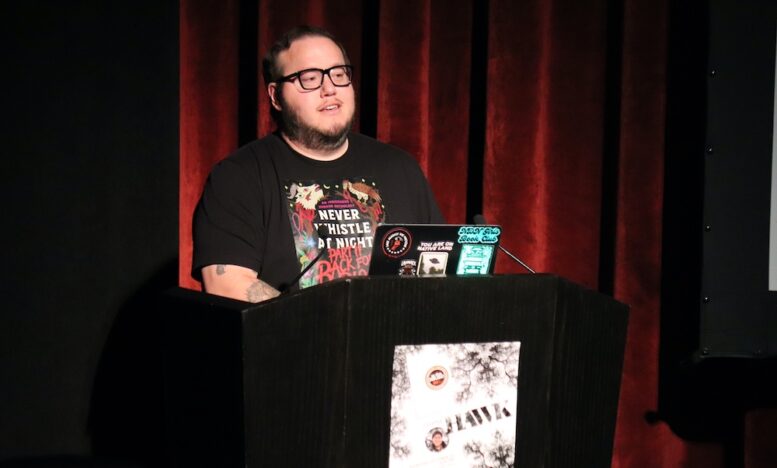
Through nonchalant wit and intellect, horror writer Shane Hawk presented his ideas on indigenous storytelling, the literary industry, and social politics during a talk at Bowling Green State University
Hawk spoke at BGSU’s In The Round: a Speaker Series Featuring Native American Creatives. The series includes discussions from Native American creatives, aiming to generate more nuanced perceptions of Native people and move away from harmful stereotypes.
Hawk’s presentation, titled “Narrative Sovereignty & the Indigenous Horror ‘Groundswell,’” marked the 15th In The Round talk, according to Dr. Ellen Schendel, dean of the College of Arts and Sciences.
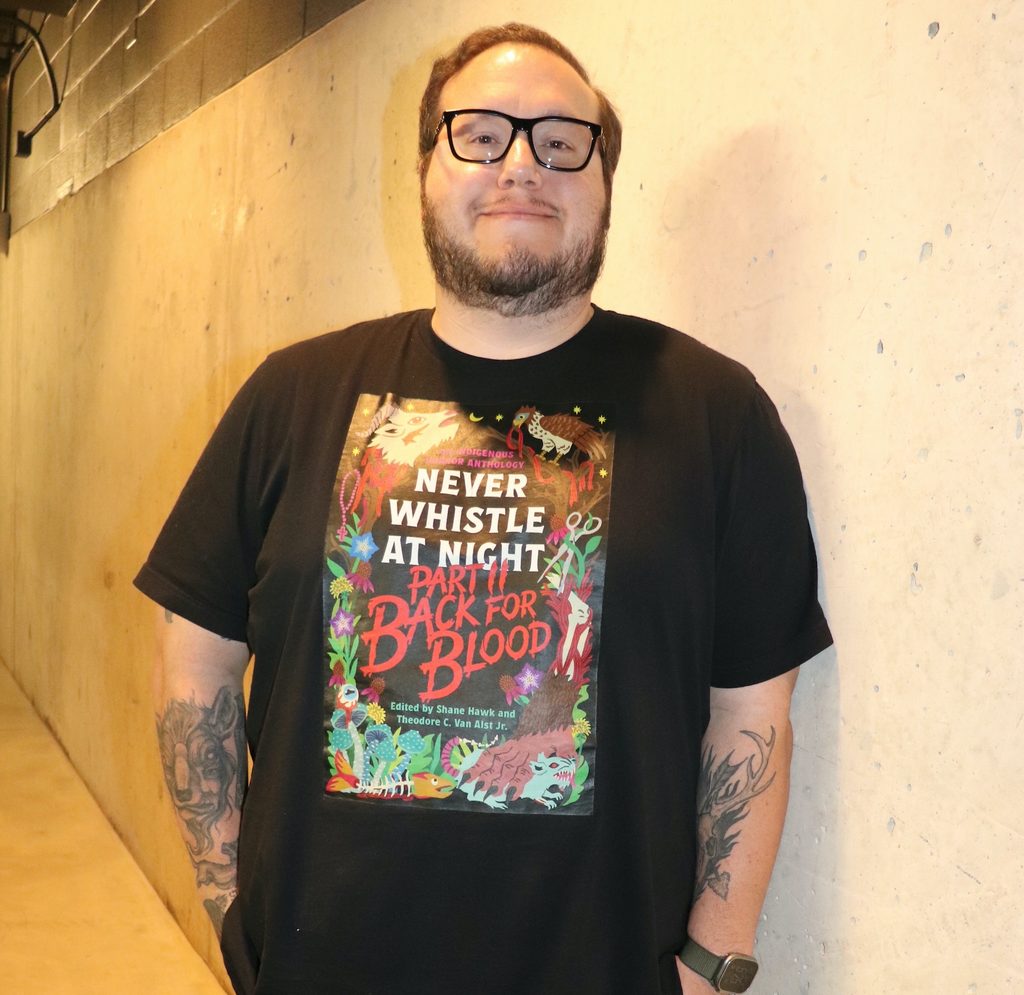
Belonging to the Cheyenne and Arapaho Tribes of Oklahoma, Hawk spoke about the “Never Whistle at Night “anthology series, collecting short horror stories by contemporary Native writers. The second volume of the series, titled “Never Whistle at Night Part II: Back For Blood,” was released last August.
Hawk is the creator of the Native Horror Index, an encyclopedic record of information about Indigenous horror writers.
“That’s a passion project,” said Hawk. “Basically, it’s a database of all horror creatives that happen to be also Native American and/or Indigenous. It’s really, in my opinion, a useful resource, both for non-Natives to discover cool Natives doing horror stuff, podcasts, movies, music, books of course, comics. And then Natives, for us, to discover ourselves.”
Through working on the Native Horror Index, Hawk found horror to be prolific and pervasive among the hundreds of Native tribes in America.
Hawk also considers horror’s entertaining quality, how kids have fun scaring each other with stories, and how the genre can be used by parents and guardians to set up expectations for our youth.
“Through traditional storytelling, a lot of what you can see acts as a sort of proto-horror in that with our learning stories and our warning stories,” said Hawk. “We have creatures that are real and also made up. It’s a mixture. And a lot of those stories are usually trying to shape the behavior of children and trying to set boundaries within your community. And some of them are conjured, you made up, and then some of them are actually real.”
Hawk spoke about horror fiction as a mode for socio-political commentary, using it to establish social and cultural norms as well as warnings of contemporary threats.
“It can be that,” said Hawk. “It can be literally, maybe there’s a lake that’s poisoned by some corporation or settlers or something and you make up a story that means don’t go in the lake, but you don’t say that up front because children aren’t going to understand that. So, you make up maybe a monster or something else and then it turns into lore in a way.”
Regarding the shift away from stereotypes, Hawk’s talk focused on his attachment to a contemporary movement of Indigenous creators working to reform America’s general cultural perceptions of native people. He used the term “groundswell” to indicate an era of Native people being unapologetically themselves and their own people, solidifying the value of their cultural identity.
The intent of “groundswell” is to reject the generalization of Native people as one large, vaguely identified group. Instead, the movement pushes for acknowledgment of the varying tribes considered under the umbrella of Native people, each tribe holding their own cultural traits.
Concerning popular culture, Hawk discussed the importance of extinguishing lazy tropes in literature, film, and TV for positive change in the perception of Indigenous people to occur. Arguably, the use of the Indigenous character as “Magical Guide” and the “Cursed Burial Ground” trope needs to end.
“[Indigenous horror is] informed by intergenerational trauma, what our ancestors have gone through and are currently going through,” Hawk said about proper representation of Native people in storytelling. “It’s tackling a lot of different issues in our different communities.”
Additionally, Hawk mentioned that he played guitar in thrash, deathcore, and hardcore bands in his youth, as well as dabbling in graffiti and creating zines. Ostensibly, much of Hawk’s ideology stems from his longstanding personal attachment to a DIY punk ethos, leading to a tendency to challenge established systems through creative efforts.
An hour after the talk, Hawk accompanied Wood County Park District’s Program Naturalist Jim Witter for a “Spooky Night Walk” through part of the Black Swamp Preserve, where Witter explained some hair-raising peculiarities that characterize animal interactions and behaviors, to which Hawk followed up with stories about spiritual visitors from his past.
Visit Hawk’s website to learn more about him, his published work and to purchase his 2020 short story collection, “Anoka.” The Native Horror Index can be found here.


