
By JAN McLAUGHLIN
BG Independent News
Bowling Green City Council sided with neighbors and against spot zoning Monday evening. During a public hearing before the council meeting, six residents defended the single-family zoning in their neighborhood of North Main Street and Curtis Avenue.
The neighbors asked that City Council not support the request that a home built around 1900 be rezoned R-2, which would allow for a duplex. With a vote of 4-2, council agreed with the neighbors and denied the request to change the zoning from Pedestrian-Residential.
Voting against the zoning change were Mark Hollenbaugh, Jeff Dennis, Kathleen Dennis and Joel O’Dorisio. Voting for the zoning change were Katelyn Elliott and Bill Herald. Council member Jordan Musgrave was absent. In September, the city planning commission voted 7-2 to recommend the city council reject the request.
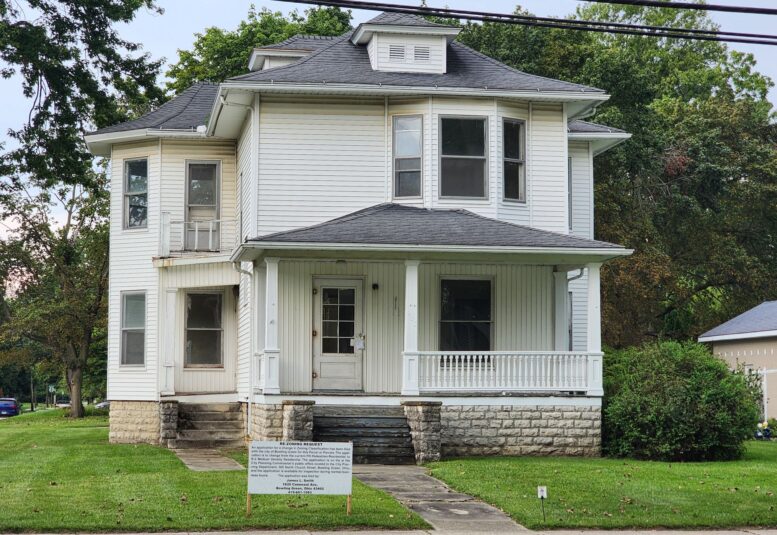
The house, owned by James and Patricia Smith, sits at 903 N. Main St. The structure has reportedly been vacant for years, and has fallen into disrepair. Housing inspections by the Wood County Health Department have cited the owner for multiple violations.
A.J. Smith, son of the owners, told the planning commission that the house has been used as a duplex over the years. “This is a rental neighborhood,” he said.
But others at the meeting pointed out that the existing duplexes in that area of North Main Street are legal non-conforming, and were used as duplexes prior to the city’s new zoning code update which created the Pedestrian-Residential zoning in 2023.
At the end of the public hearing, Smith said if the zoning request was denied, the house will be used as a fraternity or sorority house.
“It’s going to be the exact people that they don’t want,” he said.
Elliott objected to that characterization. “Personally, I welcome everyone to our community,” she said.
Elliott said she supported the zoning change because she hears from a lot of young people in the community who can’t find affordable housing.
“They are incredibly concerned about the housing crisis,” she said. “Hoping that new housing will come in the future” is not a solution, Elliott said.
Jeff Dennis acknowledged the lack of housing in Bowling Green. “We do need more housing. We need more types of housing.”
But the answer isn’t changing one house at a time. He suggested the city should re-evaluate zoning regulations. “We should not be spot zoning,” he said.
Kathleen Dennis noted that the home at 903 N. Main St. has been vacant for more than a decade – so if the owner puts it back in livable condition, it will add to the housing stock.
But Jeff Dennis pointed out that the owner said the property is not financially viable if it can only be rented out as one unit rather than a duplex.
O’Dorisio said he didn’t support the last spot zoning that came before council involving a historic home on West Wooster Street. And he doesn’t support this request. If the city wants to allow duplexes in Pedestrian-Residential areas then the zoning code needs to change, he said.
Herald said the zoning request “is not clearcut.” He noted the property owner has agreed to making more parking space available to the home – however, there are no guarantees, he added.
While it would be spot zoning, a duplex would conform with a lot of the rental units in the area, Herald said, suggesting the city revisit a “conditional use” provision for duplexes in Pedestrian-Residential zoning.
During the public hearing prior to Monday’s City Council meeting, Smith and six neighbors offered their perspectives.
Smith said the house had historically been used as a multi-family dwelling – which was questioned by some who researched the house.
Smith noted that he had just heard BGSU President Rodney Rogers and BG Mayor Mike Aspacher on the news talking about the need for more housing in Bowling Green. Smith was offering to help.
“I love this town. I live three blocks away,” he said.
He added that he had counted 26 rentals in a four-block radius of the house on North Main.
Curtis Avenue neighbor Tom Kiger said the house would make a nice fixer upper for a family or young professionals moving to BG. He pointed out that the city’s land use plan encouraged that homes being previously divided into apartments be turned back into single-family homes.
Sherry Layman, also of Curtis Avenue, said she isn’t opposed to rentals. All of the rentals on her street are single-family homes, she said.
But neighbors did not like the idea of the house being zoned for a duplex, with a possibility of four bedrooms on the first floor, and another four bedrooms on the second floor.
That could lead to a “slippery slope,” Layman said.
Lee Liebetreu, who lives right next to the house on North Main, said the home has been allowed to deteriorate, and the thought of eight students living next door was disturbing.
“I’ve invested every dollar I have in the home I live in,” she said, predicting her property values would plummet if the house became a duplex. “I’d like to think my quality of life means something to all of you.”
Liebetreu said the house at 903 N. Main St. hasn’t been maintained for 10 to 12 years. “It looks kind of like a dump,” she said.
Kiger said there is not enough parking for a potential eight renters. Lynn Pearson, who also lives on Curtis Avenue, shared concerns about congestion on the street, already making it difficult to turn off North Main onto Curtis.
Tom Knox, who lives in a Pedestrian-Residential zoned area of North Maple Street, said he recently bought the duplex next to his home. The rental had become dilapidated, and Knox has plans to restore it. He advocated for the city sticking with the zoning code adopted to preserve historic single-family homes.
“The zoning code needs to be followed,” he said. “Spot zoning in a case like this is the death of a zoning code.”
Knox also defended the neighborhood. “North Main is a primary first impression” for the city, he said.
Though Smith said the house had been a duplex for years, Knox said the kitchen on the second floor was for visiting family, and there is only a single water meter and a single electric service.
Knox said the owner should not be granted the zoning change just because he now says he intends to spruce up the property.
“The house has clearly suffered neglect,” he said. “Rezoning should not be the reward for vacancy and owner neglect.”
Winnie Rex, who spoke on behalf of the BG Save Our Neighborhoods Group, asked City Council to deny the zoning change request. City officials and citizens worked hard on the zoning code update, with more than 600 residents signing a petition in support of the Pedestrian-Residential zoning that addressed the loss of owner-occupied homes in the city.
The zoning classification was intended to slow the conversion of single-family homes into income-producing multi-unit rentals. Rex encouraged the city to work with local organizations and residents to support the rehabilitation of older homes and return them to being viable owner-occupied dwellings.
When the public comment period was over, O’Dorisio said he had heard no compelling reason to grant the zoning change.
“The community has spoken – quite forcefully,” he said.