By DAVID DUPONT
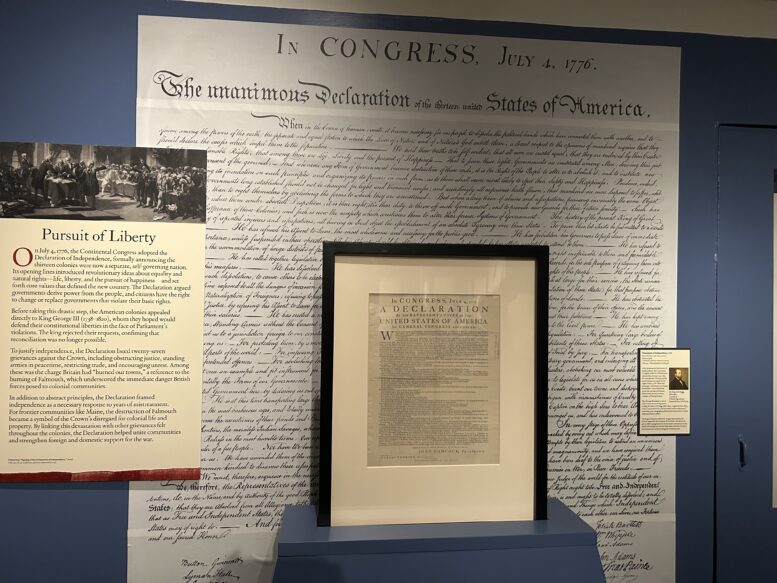
As the United States celebrates the signing of the nation’s declaration of independence, many online are drawing comparisons between this landmark and the nation’s marking of another milestone, the Bicentennial.
The conventional commentary is that 1976 was a better time. Americans were more united. The Vietnam War and Watergate were behind us. And we had the Tall Ships.
The upstart news source Hell Gate reports that Tall Ships are again sailing to the Big Apple, though The Taylor Swift-Travis Kelce nuptials may take some wind from their sails.
At 72 I’m old enough to remember ’76. I don’t share the nostalgia for that time. That’s not to say that 2026 is better. Emphatically not. The celebrations of the 250th have been hijacked by a certain would-be tyrant and grifter. A toxic narcissist suffering from cognitive decline, who can hardly get his tongue and brain coordinated to spit out
“semisesquicentennial.” As with some much he does it flops at great expense to taxpayers. Though as the hated for being right legacy media his crypto currency scheme, including the aptly named $TRUMP meme coin that’s brought him more than $1 billion from the pocket of his supporters.
I can still hear the echo of Nixon pronouncing: “I’m not a crook.” That line still resonates more than a half-century later though Vice President Vance thought it would be a 12-hour news story now, and maybe its right given the scope of his boss’s high flying, courtesy of Qatar, scams.
In 1976, the Watergate scandal was still a festering sore, as was the Vietnam War, and the assassinations of the 1960s, starting with John Kennedy, then Malcolm X, Martin Luther King Jr., and Bobby Kennedy as well as the attempts on George Wallace and Gerald Ford. The country had not recovered. The 1972 election with its landslide victory for Nixon was a spike in the heart of New Deal liberalism. I had canvassed for McGovern during the general election, though I supported Shirley Chisholm during the primaries. (Interesting fact that I just learned: At the Democratic convention the state that cast the most votes for Chisholm was Ohio.)
The Democrats nominated a moderate Navy man and peanut farmer from Georgia Jimmy Carter. While I understand that now Carter is rightly admired for his post-presidency, in the summer of ’76 I found Carter self-righteous and conservative. Still his assessment of the state of the populace in his 1979 speech, dubbed “the malaise speech,” did capture the spirit of the time. “Malaise” also was an apt description of the economy he inherited and couldn’t turn around.
In 1976, I had just graduated from the University of Massachusetts in Amherst with a self-designed major in Jazz Studies. It was more a liberal arts degree than a music performance degree. There was no jazz program at the time, though a recent article in the alumni magazine made it seem like there was something of a structured program. The music department like most others had yet to embrace jazz aside from the jazz ensemble, which was started by a music librarian. My vision of jazz studies was to not just transcribe solos and spend hours in the practice room, though I did both, but also under the cultural context in which the music was conceived. I was pursuing an approach to education that I later, when my offspring were of age, as pursuing your passion but also acquiring marketable skills. For me those were courses in journalism and writing.
Despite an uncle’s concern that this would leave me unemployable, it actually provided a grounding for what became a career in local journalism, culminating in the founding of BG Independent News.
But that’s not something I envisioned as a 22-year-old living with my parents in South Hadley, Massachusetts, biding time for my life to begin.
My girlfriend, who in the ardent naiveté of a 22-year-old I imagined to be the one, the love of my life, was 1,100 miles away, also at her parents’ home, though she spent more time on Isle Royale National Park, guiding high school back packing trips.
I was working the same job I had after graduating high school as a ride operator at the local amusement park. I also played my trombone in the local musician union’s big band, except now I was playing lead.
I don’t recall the Bicentennial Celebration coloring those much. I picked up a couple parade gigs. I remember being in the dark at the far end of the Sky Ride, a repurposed ski gondola, where there was a small zoo. The screeches and howls emitted by the terrified animals were horrifying.
They echoed what I was feeling about the Bicentennial celebrations. I saw a country heading toward more conflict, violence, and environmental degradation. That spring and summer bombings by a radical prison reform group rocked Boston. I saw irrationality of extreme ideology as a major threat to the country. But then what would I know. I was “just a little crazy, spoiled college student who’s not very experienced at anything,” or at least that’s how I described myself.
Yet those fears were not unfounded. It’s just took longer, with one hopeful detour, to get here, to place where we’re nostalgia for a time of emotional as well as economic stagflation.
These memories come from a letter typed out in the storage area of my parents apartment just after midnight on July 4, 1976.
That summer I wrote letters every day to the girl in Michigan, with whom I lived in Amherst and would live that fall in Montpelier, Vermont, if all went as planned.
I hacked out dense, singled spaced paragraphs daily before sending the clutch of single spaced pages off to Michigan. They were reflections and reports on mundane matters involving our previous apartment, plans for staying a few weeks with a socialist household, before settling into Vermont. (They were impressed with my membership in the American Federation of Musicians — there are cultural workers! And gobsmacked on meeting my father, a muscular, wizened guy whose compact frame bore the imprint of 40 years of factory work.)
The words were typed out on my new IBM Selectric, unedited raw typos and mistakes I didn’t even know were mistakes, a screed de coeur.
In preparation for writing this screed, I went up to the office space in our new home in Kennebunk, Maine, and retrieved the letters. Hard reading for being so candid and true.
They were easy to find because my wife serving as the project manager of our move did a good job as we packed to move from Bowling Green, Ohio, identifying the contents of the boxes that held the story of our lives.
See, Linda Brown did turn out to be the one. We’ll celebrate our 48th wedding anniversary in early August with the family that brought us here, our daughter Alma-Lynn, her wife, Hilary, our two and a half year old granddaughter Lua, and the new baby due to make her arrival in July.
Together we’ll continue to fight the good fight. For all that’s happened, I’m actually more hopeful now. But what do I know: I would not call myself spoiled, but certainly I’m still cranky. I’m an old guy who has experienced the joys as well as trials and sorrows of life, and I am savvy enough to appreciate for all the rawness the insights of his 22-year-old self.