By JAN McLAUGHLIN
BG Independent News
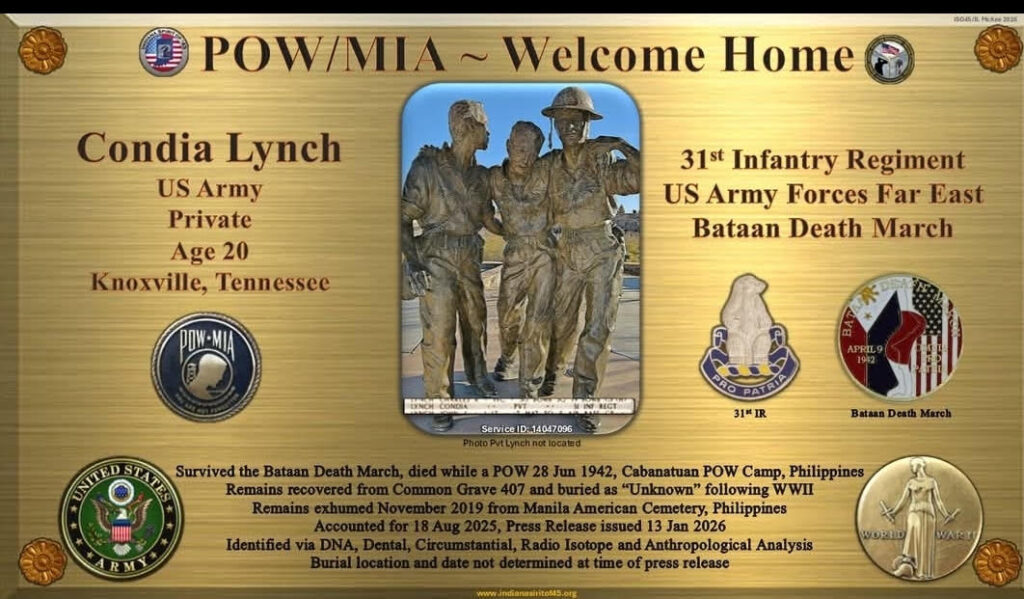
More than 80 years after dying in a Japanese POW camp, a Bowling Green man’s remains have come home to rest in the U.S.
U.S. Army Pvt. Condia Lynch Jr. survived the Bataan Death March, but later died June 28, 1942, in Cabanatuan POW camp, and was buried in a mass grave.
His family back in Bowling Green held out hope that Lynch’s remains would someday be identified so he could be laid to rest on U.S. soil. His niece, Paula Henrion, who lives in Bowling Green, said her mom submitted DNA to help with the search.
“Unfortunately she passed in 2020 without ever knowing he would come home,” Henrion said of her mom, Ida Lundy.
“Maybe she does know,” Henrion said with a sigh.
Condia Lynch moved to Bowling Green as a teenager, and joined the Army during World War II.
“Like most men of that generation, he enlisted,” his niece said.
He left behind five younger sisters in Bowling Green.
“They adored him,” Henrion said. “My mom said he was the kindest, sweetest boy.”
In the fall of 1941, Lynch was a member of 31st Infantry Regiment, when Japanese forces invaded the Philippine Islands in December – eight hours after attacking Pearl Harbor.
General Douglas MacArthur reportedly believed the lushly vegetated Bataan peninsula would provide adequate defensive cover for his troops while they waited for relief to come.
Four months later, increasingly desperate U.S. and Filipino forces were nearly out of food, medicine and ammunition. Disease and hunger were rampant. Reinforcements had not arrived.
Intense fighting continued until the surrender of the Bataan peninsula on April 9, 1942, and of Corregidor Island on May 6, 1942.
The captives, estimated at 72,000 people, were forced to march north into prison camps, where some languished for nearly three years.
Lynch was among those reported captured when U.S. forces on Corregidor surrendered to the Japanese. He was subsequently held at the Cabanatuan POW camp.
According to prison camp and other historical records, Lynch died on June 28, 1942, at the age of 20. His name is included on the Cabanatuan roster along with 1,155 other soldiers who died in the camp.
Back in Bowling Green, Lynch’s mother got a letter saying her son was in a hospital following the standoff in Corrigidor. His family feared he had perished during the Bataan Death March.
His youngest sister, Ida Lundy, passed away without knowing he died at the POW camp.
“It was brutal there,” Henrion said. “It was nothing my mom needed to know.”
Then more than 80 years later, the Defense POW/MIA Accounting Agency announced that Lynch was found on Aug. 18, 2025.
To identify Lynch’s remains, scientists from DPAA used dental, anthropological, and radio isotope analysis, as well as circumstantial evidence. Additionally, scientists from the Armed Forces Medical Examiner System used mitochondrial DNA analysis, mitochondrial genome sequencing data and nuclear single nucleotide polymorphism testing.
Although interred as an “unknown” in the Manila American Cemetery Memorial, Lynch’s grave was cared for over the past 70 years by the American Battle Monuments Commission, along with others still missing from WWII. A rosette will be placed next to his name to indicate he has been accounted for.
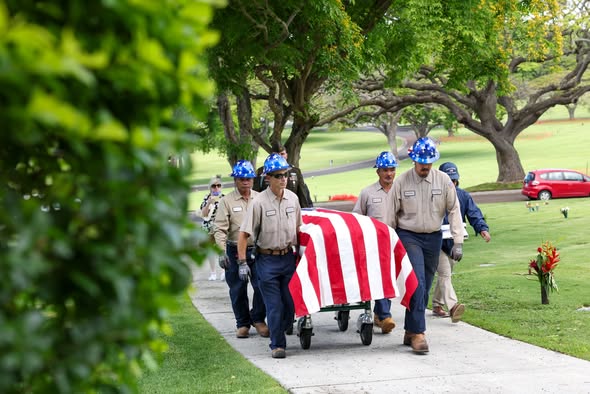
DPAA personnel gathered at the National Memorial Cemetery of the Pacific in Hawaii on May 14 for the interment.
“I am grateful to the US Army for bringing him home and properly burying him with honors,” Henrion said.
Lynch, who is listed on the WWII memorial at the Wood County Courthouse, was awarded the following medals: World War II Victory Medal, Bronze Star, Prisoner of War Medal. Combat Infantryman Badge, Purple Heart, Marksmanship Badge, American Campaign Medal, Army Presidential Unit Citation, Army Good Conduct Medal, and Asiatic-Pacific Campaign Medal.
“We’re happy he’s home, that he had a funeral, and that he was buried with honors,” his niece said.