By JAN McLAUGHLIN
BG Independent News
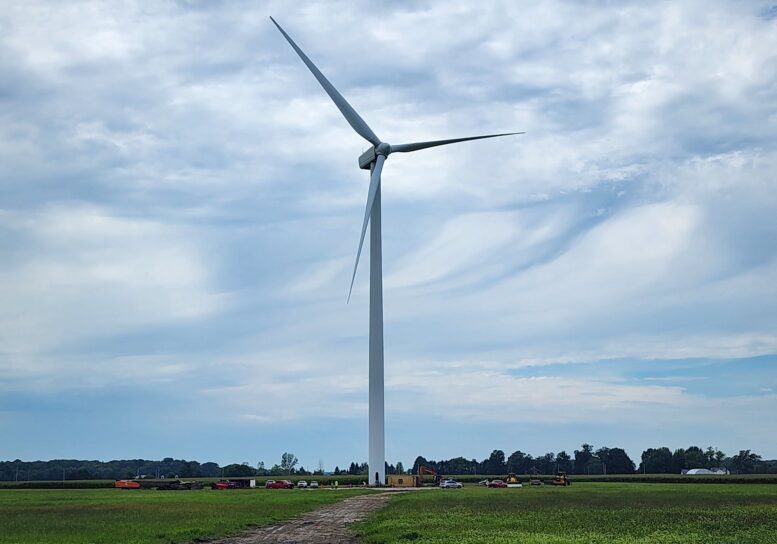
After lumbering along past their normal lifespan, the towering wind turbines west of Bowling Green are coming down.
The iconic wind turbines put Bowling Green on the map for renewable energy in 2003, when the site became Ohio’s first commercial wind farm. Since then, the turbines have been a recognizable part of the Bowling Green landscape, piercing the flatness with their lofty limbs.
But on Monday, crews gathered at the base of the turbine closest to U.S. 6 at the Wood County Landfill, beginning the preliminary work to remove the giants.
The process won’t be easy and it won’t be cheap.
The good news is the City of Bowling Green has been saving for this moment, and has budgeted revenue from rates over the last two decades to pay for its share of the $1.77 million demolition costs.
“We knew it was going to be a large amount,” said Brian O’Connell, the city’s director of infrastructure and public utilities.
Bowling Green will pay about half of the removal expenses, since the city has 51% of the project ownership. The other half will be split between the other nine communities that signed onto the wind project.
The wind farm was developed by American Municipal Power Inc. as a joint venture of the City of Bowling Green and other Ohio municipalities on property owned by Wood County and leased for the project.
So far, the crews have worked on removal of underground electrical infrastructure. Next will come the dismantling of the four turbines, one at a time. Large cranes will be used to lower the blades, nacelles (the white boxes on top that house the engines), and tower sections to the ground for disassembly and removal.
Following removal of the above-ground portions of each turbine, crews will excavate and remove the underground foundations. The foundations extend approximately 33 feet below ground and will be removed through excavation without the use of blasting. Each site will then be backfilled, inspected and restored.
By the end of the year, it is expected that the flat landscape will no longer be interrupted by the tall turbines.
Materials from the turbines will not be disposed of at the Wood County Landfill. The contractor intends to maximize reuse and recycling throughout the decommissioning process, including recycling metals, wiring and concrete, recovering oils and fluids when possible, and evaluating major turbine components for potential resale or reuse.
BG claim to fame
The city’s previous utilities director, Daryl Stockburger, was the push behind the wind farm in the early 2000s
“That was a one of a kind project,” O’Connell said. “In Ohio, nobody else had done that. Nobody.”
The turbines became a trademark for the town.
“Everybody recognized when you saw the turbines you were getting close to Bowling Green,” O’Connell said.
O’Connell recalled seeing the towering turbines for the first time, when he came to Bowling Green in 2004 to interview for a job in the city’s engineering department.
“I had never seen anything like that,” he said. “They were shiny and new.”
But they are no longer shiny, the technology is ancient by today’s standards, and replacement parts became almost impossible to find.
“It’s sad to see them coming down,” O’Connell said. “They were great while they lasted.”
The original capacity of the project was 7.2MW – which was enough to supply electricity for approximately 2,500 residential customers. The energy production was cut to 5.4 megawatts in 2021 when one of the turbines was retired early due to the expense of repairs.
The project has been a success for Bowling Green as a green energy source and a statement of the city’s values.
“The wind turbines have been a landmark on our western horizon for two decades,” O’Connell said.
After watching the turbines limp along for the last couple years, the city formally decommissioned them in 2025 after they reached the end of their 20-year operational life, and their maintenance contract was no longer renewable.
Replacement parts were hard to find, the repairs were taking longer, and the turbine productivity suffered in the last few years. Plus repairs weren’t cheap. Failed gearboxes could cost up to $500,000 to replace. And arranging for a crane tall enough to make the repairs was time-consuming.
AMP originally considered replacing the units, O’Connell said, but there were issues with the site. Most manufacturers want to put in bigger units, which would reduce the number of turbines that would fit on the site to two. To be profitable, more units would have to fit on the site.
And the costs are steep. When the wind turbines were erected, they cost about $2 million a piece. In 2020, the cost to replace them with newer models was estimated at $8.8 million a piece.
Looking to the sun
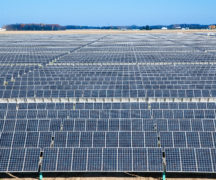
Bowling Green is already partnering with AMP Ohio for the 20MW solar field east of the city on Carter Road.
With the loss of the turbines, the city has plans for more investment in solar projects.
To replace the green energy production lost with the turbines leaving, city officials initially considered a possible solar field on acreage the city already owned near the county landfill. However, that plan fell apart when Plain Township officials passed an ordinance banning solar fields, explained Jim Odneal, the city’s assistant utilities director.
So the search began again, and this time some partners voiced interest in leasing farmland to the city for the project.
Those partners are Bowling Green State University, which plans to lease 50 to 60 acres for a solar field southwest of the Newton Road dead end at Interstate 75, and an affiliate of Principle Business Enterprises, which may lease 20 acres at the southeast corner of Devil’s Hole Road and I-75.
These properties are strategically located adjacent to the city’s electric distribution system, which helps minimize interconnection complexity and associated costs, Odneal said.
BGSU and Principle Business Enterprises will continue to own the land. The developer will own and operate the solar arrays, which will be purchased locally from First Solar. And the City of Bowling Green will buy all the power generated at the two fields. The cost is expected to range between 5 cents and 7 cents per kilowatt hour, Odneal said.
The new solar project is expected to help in managing system peak demand and reducing transmission and capacity costs, Odneal explained. And it is intended to replace the renewable energy previously supplied by the wind turbines, which accounted for approximately 4 MW of wind capacity prior to their retirement.
“We’re very hopeful,” that the city can partner with BGSU and Principle Business Enterprises on their acreage, O’Connell said on Monday.
As for the removal of the turbines, the overall project is expected to continue through December, with completion currently scheduled for mid-December. The schedule is subject to change, since portions of the dismantling work are weather dependent.
The work will not impact public access to the Wood County Landfill. However, residents and motorists in the area may notice increased activity at the site, particularly as large cranes are assembled and used during turbine removal. Following removal, the property will not be reused for renewable energy generation because of the county’s future landfill needs and Plain Township’s zoning restrictions on solar development.