By JULIE CARLE
BG Independent News
Wood County Alcohol, Drug Addiction and Mental Health Services is shifting its organizational management to become more proactive and less reactive for improved outcomes.
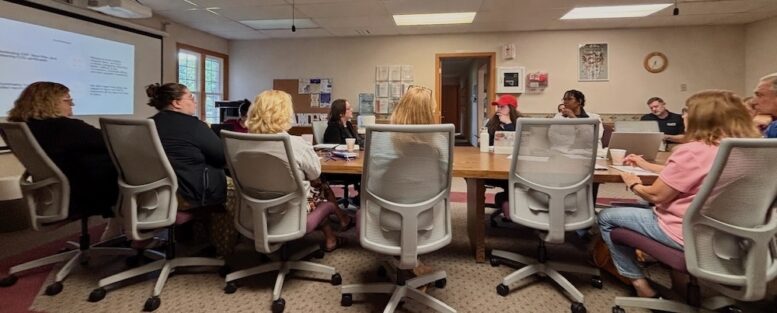
At the Aug. 24 board meeting, Executive Director Amanda Kern outlined the staff’s summer work to develop a more systematic approach to planning and implementation of behavioral health services in the county.
They looked at the three plans they are responsible for.
“We have been rewriting all our policies and bylaws and doing all this work to build these really thoughtful plans,” she explained.
The office operates under three plans: Community Assessment and Plan (CAP), a state-required plan every three years that evaluates local behavioral health needs, identifies service gaps and guides funding priorities across the continuum of care; strategic plan; and the culture of quality.
“There’s a lot of data collection that goes into it,” Kern said. “We survey all our community partners, our providers, our clients, our families and friends and community members to identify what’s working well in our system and what are our barriers in our system.”
The state requirement includes addressing needs of specialized populations, such as pregnant women who are trying to get cleaned from drugs and alcohol.
Additionally, WCADAMHS decided to align the organization’s strategic plan process with the CAP. Every three years, staff will build the strategic plan based on the data collected for CAP.
The strategic plan, written for “anybody to pick up, read and digest,” will include more than 40 individual tasks that the agency needs to complete over three years.
The third component is the culture of quality certification process (COQ), also completed every three years. The COQ looks at human resources, fiscal and governance sections.
“We did all the work to get the certification, and are functioning at the highest capacity, effectiveness and ethics,” she said. “Now, we have to do the work for when they come back in three years and check it.”
As they reviewed all the plans, each one written differently, they found plenty of overlap.
An added element is the Wood County Health Department’s Community Health Improvement Plan (CHIP), which the health department has asked to partner with WCADAMHS.
“It has been our hopes and goals to build the CHIP and CAP together,” Kern said. “It feels like we are on track to start doing that.”
As the two agencies work together, Kern said they plan to replace the CHIP behavioral health plans and goals to “reflect ours. Together we are coordinating all the efforts for physical (WCHD) and behavioral (WCADAMHS) health for the county.”
Looking at all the plans “was a lot of information,” she admitted. “They sat down and created a crosswalk of all of it, every task, and pulled them into one document to start identifying the priorities and overlaps.
From there, they assigned ownership and started identifying “there was a very different way to manage the work of this agency,” she said.
They created five workflows, assigned to Kern and the directors: Workforce Development that includes clinical-based training, expanding peer supports and evidence-based practices and supporting the agencies, expanding, assigned to Kern and Aimee Coe; Access, tracking how long it takes from first call for help to assessment, to first therapist visit to getting on medication, Kern and Laura Fullenkamp; Housing and Recovery Supports, Kern, because she is a member of the Wood County Housing and Homelessness Coalition; Prevention and Community Resilience, Coe and Kern; Data Quality and Organizational Excellence, Fullenkamp and Kern.
“We now know the nine goals that we are trying to accomplish together, and together we can sit down and design the action steps to get to each of the tasks done,” Kern said.
Every year, she can update the community and board about the agency’s performance in the previous year to make adjustments for future programming.
HUD apartments, ruined by fire, to be rebuilt
Construction to rebuild the HUD apartments at 311 Parkview Ave. that caught fire in June 2024 should start this fall, Harbor CEO Dustin Watkins told the board.
“We’ve been working with HUD and the insurance company, which has been easier said than done, but we were able to finalize the drawings, take it out for bid and got the bids in,” he said. “We should be able to start (construction) within the next month or so and hopefully have everything done by spring and ready for move-in.”
Any of the people displaced from the fire will have the first opportunity to move back in; however, some have found alternative housing, “so we don’t anticipate that everybody will want to move back in,” he said.
TIP housing update
Board Chair Erica Parish asked if funding for Harbor’s Transition to Independence (TIP) housing was resolved to keep both houses open. Kern said decreased funding required collapsing the two houses into a single, 24/7 staffed, segregated, co-ed house.
Harbor worked with local offices and the Department of Behavioral Health to get all of their certifications in place to be able to expand the number of beds in a single house, “so that we could hopefully keep as many beds as we could available to the county,” Kern said.
They attempted to work with Great Lakes Community Action Partnership to try to access HUD funds to support individuals going into HUD houses. However, to secure HUD dollars would have required that Harbor eliminate its Class 2 Residential status, which the ADAMHS board requires.
“We couldn’t ask them to remove that residential status,” Kern said. “That means the funding that we have on the table is the only funding we have available at this time.”
The county board will continue discussions about continuing the single house with the available funds or determine what is needed to keep it functioning beyond six months. “We will then bring that back to the board for discussion,” Kern said.
In other business, the board:
- Authorized a one-time $1,350 bonus for Kern, equal to 1% of her salary, in appreciation of her leadership and the accomplishments of the board staff.
- Heard a state pilot program to incentivize landlords to provide housing for mental health and substance use disorder consumers was not successful, thus requiring the agency to return unused funds. “We did a lot of work trying to reach out to private landlords about the funds that were available, but we really struggled to find landlords who were agreeable to this project,” Kern said. There were quite a few counties that had similar struggles.
- Learned that issues with wi-fi connections at the three Narcan/fentanyl test strips vending machine sites have been resolved. They discussed the pros and cons of discontinuing a contract with Vendovation to save $360 a month. The software provides usage reports; however, Aimee Coe, director of clinical and prevention programs, visits the sites regularly to provide information on quantities delivered, but no timeline details.
- Heard the Wood County Educational Service Center’s Trunk or Treat for school supplies was successful. About half of the 600 families that registered showed up because of rainy weather, though the event was moved indoors, said Alana Stanbery-Sigg, director of prevention services. “Next year we will make sure we advertise very clearly: it is rain or shine.”