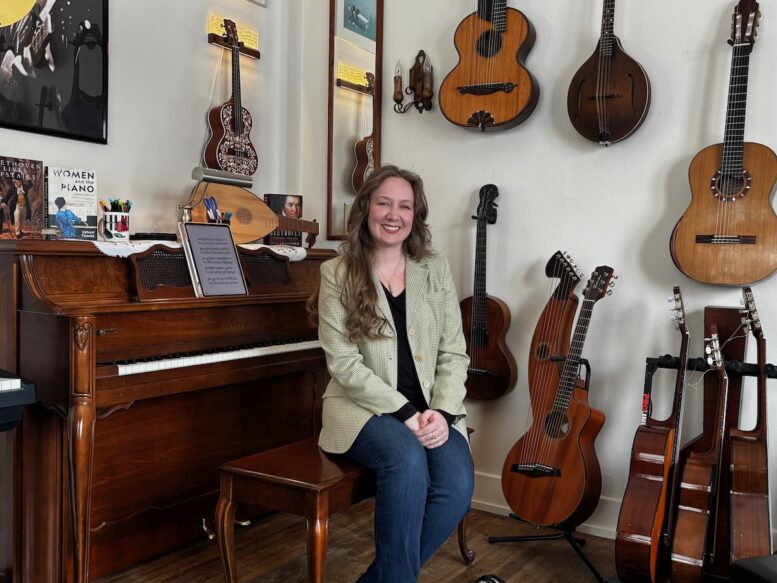
By JULIE CARLE
BG Independent News
When she was seven years old, a young pianist sat at the keyboard with a question that would quietly shape her life: “Where were the women composers?”
Sandra Coursey’s first piano teacher’s answer was blunt—there simply weren’t any. The composers, she was told, were men like Johann Sebastian Bach, Wolfgang Amadeus Mozart, and Ludwig van Beethoven.
The comment landed with the weight adults often underestimate. If women didn’t compose, the young pianist concluded, then she never could either.
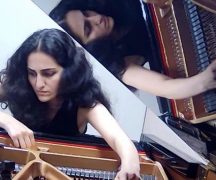
Years later, with a Doctor of Musical Arts from Bowling Green State University’s College of Musical Arts and a fiercely independent career as the Keytress, Coursey is proving that lesson wrong—note by note.
A young rebel at the piano
Raised in Oklahoma City, Coursey began piano at age seven, initially trailing in the musical footsteps of her older sister. Even then, there were hints of the path ahead. When assigned pieces her sister had already played, she quietly rebelled. Instead, she sought music of her own.
“I was practicing,” she recalled. “Just not what I was supposed to.”
That instinct—to search beyond the prescribed canon—eventually led her through BGSU’s intensive study in new music and into a realization that would redefine her career.
Even in progressive academic spaces, she noticed something missing.
“I had never learned a single piece by a woman until my master’s degree,” she said.
The birth of ‘Sleeping Beauties’
Her response became ‘Sleeping Beauties,’ an ambitious independent research and performance project devoted to uncovering piano works by women of the late Romantic era—roughly the 1890s through the 1910s.
The title is deliberately provocative.
“Sleeping Beauty is often considered one of the least feminist princesses because she remains powerless until awakened by a prince,” Coursey said. “I chose this title to reclaim power for women who have been silenced by history. The composers I researched used their own agency to share their voices. It is now up to us to listen.”
The phrase carries a second meaning from scientific literature, where “sleeping beauties” are papers whose importance is recognized only decades later. The concept transferred perfectly to the music.
All of the music identified in her research and that she now performs was published over 100 years ago, and then quietly forgotten.
“It was a time in which they were really confined to the domestic sphere, and yet, they were still writing in a way that could be performed on stage,” Coursey said. “People would say, ‘If you’re a woman doing this, then you’re considered an amateur.’ But if a man did it they were considered a professional because they were making money.”
Coursey’s answer is to devote time to finding music by women of that era. If there is no easily available recording, she makes a recording so other people can find it.
“Only now is the music receiving just some of the recognition it deserves,” she said. “Sometimes it takes the public a while to catch up to what the creators already knew.”
Hunting for lost voices
Her research is equal parts detective work and devotion. She spends hours combing the International Music Score Library Project (IMSLP), searching for female names, pseudonyms, and overlooked manuscripts.
Many discoveries come with obstacles, she said. For example, some women composers published under male aliases, and others were dismissed as amateurs because they wrote for “the domestic parlor rather than the concert hall.”
There are still others at risk of being lost entirely in private archives and family collections.
“History didn’t log them the way it should have,” she says. “If it wasn’t recorded, people assume it didn’t exist.”
Among the composers she champions:
- Charlotte Blake, an Ohio musician whose salon works subtly challenged social norms.
- Florence Price, whose manuscripts were nearly destroyed in a house fire before their rediscovery.
- Adele aus der Ohe, once a celebrated virtuoso and pupil of Franz Liszt, who performed under the baton of Pyotr Ilyich Tchaikovsky—and is now largely unknown.
Each rediscovery, she says, feels like opening a time capsule.
More than historical correction
What drives her is not just archival curiosity but emotional resonance that has roots in her love for piano that started when she was very young. The quiet, shy girl learned early on that whenever she played piano for people, she was never nervous.
“I would just become like the most confident version of myself,” she said. “So, the piano has always been a friend to me. It was, and still is, the way that I interact with the world and in my most genuine state.”
She hears something different in this music—an attention to the performer’s physical and expressive experience that contrasts with the bravura showpieces dominating the traditional canon.
“These women were often writing for people like themselves,” she said. “They cared how it felt to play the music, not just how impressive it sounded.”
That perspective has reshaped her own artistry—and her teaching.
Teaching the next generation to speak
Today, she teaches 15 to 20 students, many online and across the country. From the very first lesson, composition and improvisation are not extras—they are expectations.
Her philosophy is simple: the piano belongs to the student.
Too many adults come to her after quitting lessons in childhood because they were taught that anything not written on the page was wrong. She is determined to break that cycle.
“For my students, I want music to be empowering,” she said. “Something where they get to create a world.”
The approach is deeply personal. Ironically, she didn’t begin composing until after finishing her doctorate—still carrying echoes of that childhood moment when she believed she wasn’t allowed.
Facing the same old ‘No‘
Her mission hasn’t been universally embraced. Some presenters worry that unknown female composers won’t sell tickets.
But rejection only steels her resolve.
“Every time I get a no,” she said, “it reminds me why I do this—because those women got no’s too.”
Interest is growing, slowly. Intimate recitals have moved audiences, and students are beginning to seek out the repertoire themselves. She has a website and a YouTube channel, and is currently recording an album of previously unrecorded works and expanding performances of the project.
Why it matters now
To her, this is not nostalgia or niche programming—it is unfinished history.
“The things that impact us today often come from hundreds of years ago,” she said. “If we never acknowledge them, the cycle just repeats.”
In resurrecting these composers, she hopes to widen not only the repertoire but also the imagination of who belongs in music.
Because somewhere, she knows, another seven-year-old is sitting at a piano bench, quietly wondering the same question she once did.
This time, she intends for the answer to be different.