By JAN McLAUGHLIN
BG Independent News
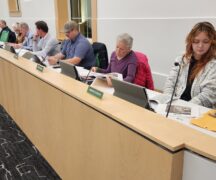
Nine residents of Bowling Green last week defended the single-family zoning in their neighborhood of North Main Street and Curtis Avenue.
The neighbors asked that the city’s Planning Commission not support the request that a home built around 1900 be rezoned R-2, which would allow for a duplex. With a vote of 7-2, the commission agreed with the neighbors and will recommend to City Council that the property remain zoned Pedestrian-Residential.
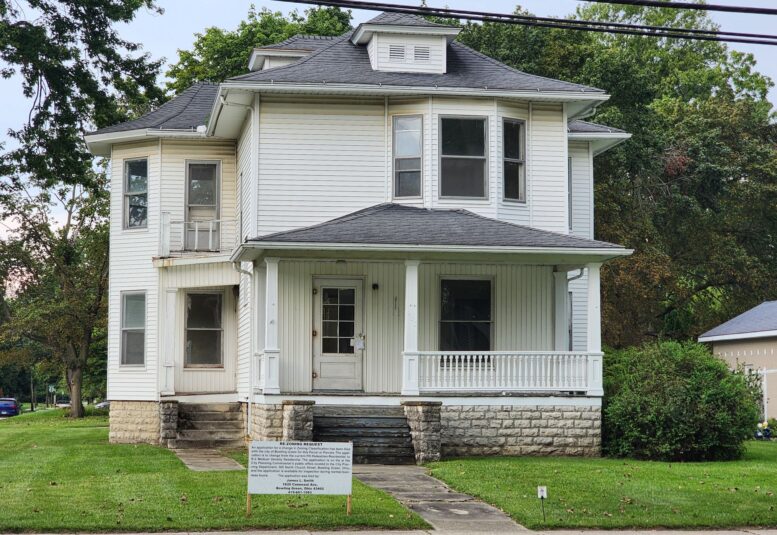
The house, owned by James Smith, sits at 903 N. Main St. The structure has reportedly been vacant for years, and has fallen into disrepair. Housing inspections by the Wood County Health Department have cited the owner for multiple violations.
A.J. Smith, son of the owner, told the planning commission that the house has been used as a duplex over the years. “This is a rental neighborhood,” he said.
But others at the meeting pointed out that the existing duplexes in that area of North Main Street are legal non-conforming, and were there prior to the city’s new zoning code update which created the Pedestrian-Residential zoning in 2023.
The neighbors did not object to the home being rented. But they did not like the idea of it being zoned for a duplex, with a proposed four bedrooms on the first floor, and another four bedrooms on the second floor.
Lee Liebetreu, who lives right next to the house, said the structure was at one time a beautiful Victorian home. But it had been allowed to deteriorate, and the thought of eight students living in one house in the single-family zoned area did not sit well with Liebetreu.
“I don’t want beer pong on the front yard,” she said.
Liebetreu and others in the neighborhood pointed out the lack of parking at 903 N. Main St., and the shortage of parking spaces on Curtis Avenue.
“Parking is at a premium already,” Sherry Layman said.
Shaun Reeves said changing the zoning to R-2 medium density would have a negative effect on the neighborhood.
“I don’t want North Main Street to look like South Main Street,” Reeves said.
Felicia Boyd, who lives on North Main, told the planning commission that she is not concerned about the home being rented, but she is opposed to it becoming higher density.
Tom Kiger, of Curtis Avenue, agreed there is not enough parking for a potential eight renters, and asked the planning commission to reject the request.
“Help us keep our neighborhood a nice strong neighborhood,” Kiger said.
Lynn Pearson, who also lives on Curtis Avenue, shared concerns about congestion on the street, already making it difficult to turn off North Main onto Curtis.
And a native of Bowling Green, who recently moved back after living in Portland, Oregon, cautioned that changing the zoning to allow greater density would harm the neighborhood.
“It’s a slippery slope,” she said. “I love this area.”
Tom Knox, who lives in a Pedestrian-Residential zoned area of North Maple Street, said he recently bought the duplex next to his home that had become dilapidated, and has plans to restore it. He advocated for the city sticking with the zoning code adopted to preserve historic single-family homes.
Knox said the owner should not be granted the zoning change just because he now says he intends to spruce up the property.
“There should not be a reward for owner negligence,” he said.
Rose Drain, spoke on behalf of the BG Save Our Neighborhoods Group Board of Directors, and asked the planning commission to deny the zoning change request. City officials and citizens worked hard on the zoning code update, with more than 600 residents signing a petition in support of the Pedestrian-Residential zoning that addressed the loss of owner-occupied homes in the city.
The zoning classification was intended to slow the conversion of single-family homes into income-producing multi-unit rentals, Drain reminded.
Changing the zoning would “undermine the goal of preserving opportunities for single-family homes,” she said.
Instead, Drain encouraged the city to work with local organizations and residents to support the rehabilitation of older homes and return them to being viable owner-occupied dwellings.
Planning commission member Julie Broadwell thanked all the citizens for speaking up about their concerns for their neighborhood. And she pointed out that she felt the same way about the similar zoning request for property at 416 W. Wooster St., that the city approved last year.
“I’m against spot zoning,” Broadwell said. “I was against the zoning request for 416 W. Wooster St., so I stand by that tonight.”
Others on the planning commission shared the same concerns about allowing the historic home on West Wooster to become a duplex, since the owner said she could not restore the home unless it was converted to an income-generating duplex.
“We set the precedent once,” Joe Phillips said. “And it’s clearly bit us in the ass.”
And Bob McOmber reminded that the current multi-unit housing in the Pedestrian-Residential zoned neighborhood was present prior to the city’s zoning code update.
Voting against the zoning change were Broadwell, McOmber, Phillips, Abishek Bhati, Judy Ennis and Amanda Denbow. Voting in favor were Bob Waddle and Mark Remeis.
Ennis pointed out that the planning commission’s decision Wednesday evening is just a recommendation, and City Council will make the final ruling on the zoning request.