
By TOM GERROW
BG Independent News
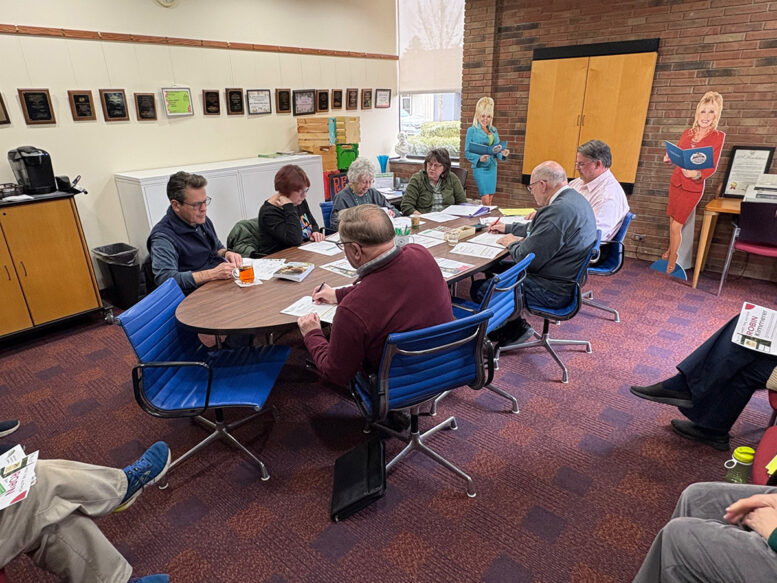
The main item of consideration for the WCDPL board of trustees at their March 17 meeting was putting a renewal of the 16-year-old local levy request on the ballot in November. The levy renewal discussion is taking place in a financially challenging environment for the WCDPL. State funding, through the Public Library Fund, has changed from a percentage of revenue to a line item in the state budget, making it subject to the annual appropriations process in the legislature. At the same time, ballot initiatives and proposed state legislation could change the property tax landscape in Ohio dramatically.
That initial levy request in 2010 was for a 0.8 mill five-year levy. That levy was then renewed in 2014 for six years and again in 2020 for six years. Support for the 2014 and 2020 levy renewals was strong, with 70 percent and 73 percent of voters approving, respectively.
“Remember we’re 150 years old, but it wasn’t until 2010 that we went to voters for the first time and asked property owners for operating revenue,” said Michael Penrod, the library director.
“Our voted millage does not increase as property valuations go up,” Penrod said. “It’s voted to bring in a dollar amount of money, and as values go up, they calculate the effective millage. The current effective millage is 0.5047 for residential and ag and 0.6980 for commercial industrial.”
The board of trustees has the option to request a simple renewal of the levy, or a renewal plus additional revenue, and to select the term of the levy. To get the levy request on this November’s ballot, the WCDPL board of trustees must pass two resolutions. The first, due next month, involves asking the county auditor for a certification for renewal and the term. Once that request is certified, in May the board must pass another resolution to forward the levy request to the county commissioners, who then send it to the board of elections for inclusion on the ballot.
Currently, the county commissioners send all these requests to the county board of elections. State legislation under consideration, however, may give county authorities more discretion over what levies appear on the ballot.
Board member Brian Paskvan, who has been on the board of trustees during previous renewal campaigns, noted that much time, effort and resources are involved in renewing a levy, including forming a campaign committee to advocate for the levy.
“There’s just lots of things to consider as we go through all this to make sure we have optimum turnout, optimum support, and spend our money wisely,” Paskvan said. “It’s a pretty big process to manage for the next several months.”
The board considered changing the term of the levy, and there were some concerns about whether a renewed 16-year-old levy would provide adequate funding in the coming years. But after discussion, the board instructed Penrod to draft a resolution asking for a simple renewal of the levy with the same six-year term.
“I think that we are doing well, from the taxpayers’ perspective, and that money is being used appropriately, and we’re good stewards of that,” Paskvan said.
“What makes me very nervous is what the state is going to do with all of this and our overall funding,” Paskvan said, referring to a change to the Public Library Fund turning it into a line item in the state budget rather than a percentage of revenue. “So I’ve been doing this 21 years, and this is the first time I got rattled this last year.”
“I have a great amount of fear about the state money reduction, a real reduction, versus the ability for us to continue to provide really strong services to the community,” said board member Kris James.
Looming over the levy discussion was the possibility of an amendment abolishing property taxes appearing on the ballot in November, right alongside the request for a levy renewal. Penrod shared a memo from the Ohio Office of Budget and Management to Gov. Mike DeWine discussing the impacts abolishing property taxes would have on cities, counties, and school districts in Ohio.
“This conversation has been happening in many other organizations,” said Ken Frisch, board president. “The townships are talking about what’s going on as it relates to November. The fire departments are talking about what’s going on. The schools are talking about what’s going on. So we’re going to be part of a larger conversation, whether we choose to be or not. We need to make the best decision for this organization based on the information that we have. But just keep that in context.
“And I think what we see here in this statement, there is no plan to replace property taxes,” Frisch added.
Penrod presented a 2025 State of the Library annual report at this month’s meeting that highlighted some of the library’s achievements over the course of last year. All library locations saw 159,462 visitors, a 4 percent increase. Circulation of physical and digital assets increased by 6.3 percent, for a total of 642,331 checkouts system wide. Penrod noted that there was a 28 percent increase in checkouts of eMedia and digital content, on top of an 18 percent increase in 2024 and a 12 percent increase in 2023.
WCDPL, which celebrated its 150th anniversary, also offered 1,140 programs and events, which drew in 36,667 attendees. These included notable author visits, the WCDPL Foundation’s Novel Night fundraiser, and many popular reading programs.
On the financial side, the WCDPL’s 2025 revenue totaled $3,537,135 and expenditures were $3,282,782. The vast majority of library revenue came from the Ohio Public Library Fund ($1,933,634, or about 55 percent) and the local tax levy ($1,187,133, or about 34 percent). The largest expenditure categories were for personnel ($1,892,061, or about 60 percent) and new materials ($618,291, or about 20 percent).
“I see the budget as a value statement,” Penrod said. “Well, this is a value realized – 19.74 percent of our budget we spent on new materials. Remember, the national average for a library is 10.5 percent. So we’re living our values. We’re buying books for this community. I’m very proud of that.”
As the WCDPL prepares to ask taxpayers to renew the levy, Penrod shared some encouraging results from a recent survey conducted by Neil Newhouse of Washington-based Public Opinion Strategies for the Ohio Library Council and the Ohio Township Association that showed strong support for public libraries. According to the research:
- 90 percent of Ohioans say public libraries are important to their local community, and rank among the highest rated local services.
- 69 percent recall a specific time their library helped them personally.
- 87 percent say they get their money’s worth from library services for the taxes they pay.
- 71 percent believe libraries provide many of the most basic services people rely on every day.
Library staff also reported a strong start to the year at the Bowling Green library, with door count data for the first two months of the year up 7 percent in January and 17 percent in February over 2025 numbers. The library has also added a bookmobile stop at BGSU to serve faculty, staff, and students on campus.
Starting on Friday, March 13, the Bowling Green library’s elevator will be out of service for up to 7 weeks while it undergoes refurbishment. The library will be fully open during this time. For those unable to climb up or down the stairway, staff from the second floor Information Desk will be able to meet and assist individuals on the first floor.