
By JULIE CARLE
BG Independent News
Food tells a story about a nation’s hopes, hardships and resilience.
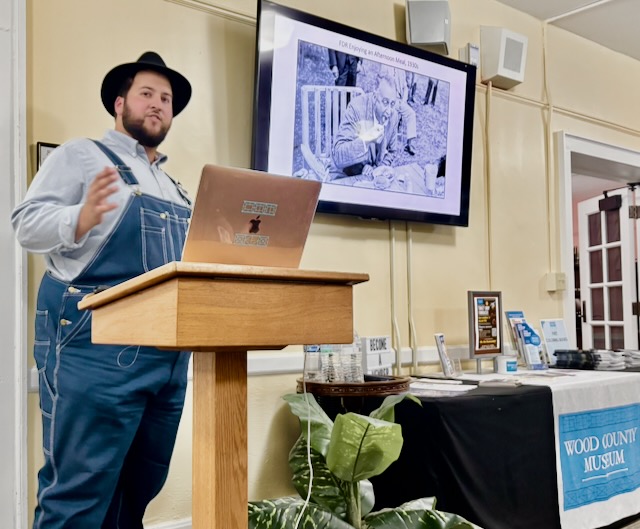
“Food history is this rich investigation in how people use food and how food unites cultures across time,” Chase Fleece, historic farm coordinator at Carter Historic Farm, told a packed room during the 10th installment of the America 250 lecture series.
The Great Depression era was no exception.
During his Oct. 20 presentation at the Wood County Museum, Fleece examined the dramatic changes in how Americans produced, prepared, purchased and accessed food during one of the most challenging periods in the nation’s history.
Because “it’s important to turn back the clock and look at what people were eating in the ’20s” compared to what they didn’t have by the 1930s, Fleece discussed Republican Herbert Hoover’s 1928 presidential election promise “that every American would have a chicken in every pot and a car in every garage.”
Hoover and the Republicans believed that the American economy was strong and that everything was going well. However, none of that was true, Fleece said, and the economy collapsed soon after Hoover won the election.
Unemployment mushroomed and household incomes disappeared making access to food an increasingly urgent problem in the U.S.. At the heart of the Depression, Fleece said many families went hungry because they could not afford food, yet American farmers continued producing enormous quantities of agricultural commodities and they struggled to find markets for their crops.
Life in the rural kitchen
Leading up to the Depression, women on farms across the Midwest carried most of the responsibility for feeding their families, Fleece said. They were in charge of preparing the meals, managing the gardens, caring for the poultry, preserving food, doing laundry and childcare on top of other household duties.
“In the 19th Century, the kitchen is the chief living room and where the heart of rural America lies,” he said. “But by the turn of the 20th century in the 1900s to 1920s, the United States goes crazy with industrialization.”
The Great American ethos focused on making everything more efficient and people more productive. “That affects all facets of American culture, especially in rural America,” he added.
Henry Ford, who was raised on a farm, hated farm life and became one of the industrialists who vowed to “change the fabric of rural society,” Fleece said.
Frederick W. Taylor, known for doing time studies in the early 20th century, believed systems of efficiency would be the path forward. His time studies found their way into rural America.
Food production in rural houses and farm families became a target for the U.S. Department of Agriculture. Farm women were believed to work too hard compared to urban women who worked less and even had time to get a job.
“The USDA put out this fabulous bulletin in January of 1921 and calls the farm kitchen ‘a workshop,’” promoting a convenient arrangement of the kitchen and the equipment, Fleece said. The revised kitchen setup would mean “lighter work and shorter hours for housekeepers and helpers.”
One of the ideas was that kitchens were too big and farm women were taking too many steps.
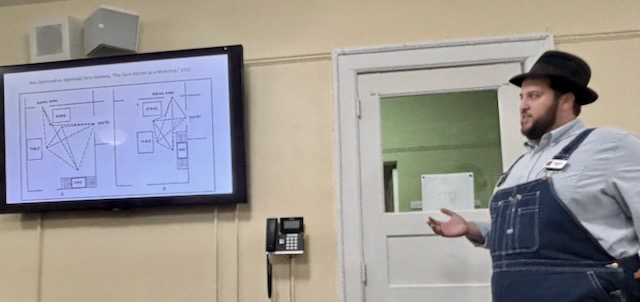
Efforts to modernize farm kitchens reflected the era’s growing emphasis on industrial efficiency. Government experts promoted kitchen layouts designed to reduce unnecessary steps and make household labor more productive. However, Fleece pointed out the real issue was more that many farm women needed basic conveniences such as electricity and running water more than advice on how to organize their kitchens.
Industrialization didn’t seem to reduce women’s daily work hours, but their husbands were working less because of mechanization of farm equipment.
Despite the labor involved, rural food traditions fostered a strong sense of community. Seasonal gatherings, including the Midwestern tradition of the thresher’s dinner, brought farm families together to feed the crews helping harvest grain. These large meals demonstrated how food served not only as nourishment but also as an expression of cooperation and shared responsibility.
Farm families also practiced a philosophy of making the most of what they had. When livestock was butchered, preserving and using as much of the animal as possible helped sustain the household through the year.
Changing tastes in America’s cities
Urban food culture followed a different path during the 1920s.
The biggest change was in labor dynamics. People were going to factories and working more hours;. There was a massive influx of immigration leading up to the 1920s. In addition to urban women getting jobs, they also gained the right to vote and are more engaged in society, Fleece said.
“As Chicago writer Ben Heck described the urban economic boom as the razzle dazzle of dreams, tragedies and fantasies, that really under all this smoke and mirrors of this new economic industrialized city, there were very many challenges and very many underlying problems that even relate to food,” Fleece said.
As more Americans worked outside the home, restaurants, cafeterias, delicatessens and sandwich shops offered increasingly convenient alternatives to home cooking.
These businesses reflected the same emphasis on efficiency transforming American industry. Customers could purchase quick lunches, sandwiches and prepared foods rather than spend time preparing every meal at home.
Packaged and inexpensive foods also became more prominent. Products such as Fritos corn chips, Ritz crackers, Kraft macaroni and cheese, and even Twinkies entered the marketplace during the Depression era, demonstrating that the decade’s food history included innovation and changing consumer tastes as well as scarcity.
However, the economic crash exposed the fragility of a food system increasingly dependent on consumers’ ability to pay. What had seemed like an expanding world of convenience quickly became inaccessible to families without steady employment or income.
Hunger amid abundance
The human cost of the Great Depression was central to Fleece’s presentation. Breadlines, food-relief efforts and reports of hunger challenged the belief that Americans could overcome economic hardship without substantial government assistance.
President Hoover’s approach to societal challenges was vastly different from Franklin D. Roosevelt’s, Fleece said. Hoover favored voluntary cooperation and assistance through private organizations, while Roosevelt, first as governor of New York and later as president, supported broader public intervention to address the crisis.
As president, Roosevelt pursued programs that connected struggling farmers with families in need. Federal efforts purchased agricultural surpluses, including meat, dairy products and grain, and directed food toward relief programs. These addressed two problems at once: falling farm prices and widespread hunger.
The programs did not solve every problem, Fleece admitted. Distribution was uneven, and some communities continued to experience severe shortages and protests over access to food. Nevertheless, the federal response marked a significant expansion of the government’s role in addressing economic hardship and food insecurity. Food became more than sustenance in American culture. It became tied to economic inequality, innovation and resilience, he said.
Many of the Depression-era food traditions have lasted and remain a part of American life, he said. Fleece involved the audience in a game to identify if some of the foods that are still around today were produced before, during or after the Great Depression.
Some of the foods developed before the economic downfall included deviled eggs made popular thanks to mayonnaise production and home refrigeration; canned Spam, due to the glut of pork and Hormel’s ability to come up with a portable, long-lasting, shelf-stable and cheap meat product; and pineapple upside-down cake, which became popular after the Hawaii Pineapple Company suggested pineapple could be used to make the cake dessert.
Kraft Mac and Cheese, Fritos Corn Chips, Twinkies and Kool-Aid were all created during the Depression.
“There were people out there eating Twinkies and Kool-Aid in 1935, the same way that people are eating Twinkies and Kool-Aid today. Convenient meals and food. Not much has changed,” he said. “Food culture, while it’s changed in some ways, some of them are still modern conveniences that kind of persisted.”