By JULIE CARLE
BG Independent News
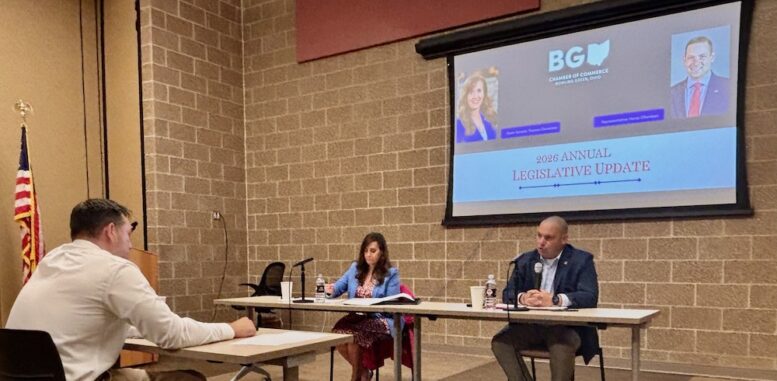
Education funding, workforce development, property taxes, transportation and economic growth were among the issues discussed as two northwest Ohio legislators fielded questions from the business community during Friday’s Bowling Green Chamber of Commerce legislative update
State Rep. Haraz Ghanbari and State Sen. Theresa Gavarone addressed questions from Chamber members about issues affecting businesses, schools and families throughout Wood County and northwest Ohio.
Ghanbari, who represents Ohio’s 75th House District, which encompasses most of Wood County, emphasized the importance of small businesses and reducing regulatory barriers to growth. He said partnerships among small businesses, financial institutions, educational organizations and workforce-development programs are critical to helping entrepreneurs launch and expand their businesses.
He also pointed to career-technical and micro-credential programs as ways to provide workers with targeted training without requiring a traditional four-year degree. Ghanbari said Ohio has also taken steps to connect education and workforce needs, including allowing graduates of certain public-safety academies to receive college credit and establishing shorter bachelor’s-degree pathways for in-demand occupations.
“For example, we have a crisis when it comes to law enforcement and our first responders. Recruiting them, training, and then sustaining them to make sure that our communities are safe,” he said. “I look at the most foundational requirement of a government is to provide for the safety and security of its citizens.”
He started a conversation with Bowling Green State University President Rodney K. Rogers and the Colonel of the Ohio State Highway Patrol that led to legislation that awards 33 semester hours of college credit to individuals who graduate from the Ohio State Highway Patrol Academy or the Ohio Basic Peace Officer Training Academy.
“We have now directed every public university in the State of Ohio to create a 90-credit-hour baccalaureate—that normally would be 120 hours—for those in-demand jobs,” he said. “Bowling Green State University decided to make their first one at least centered toward criminal justice.”
After earning 33 credits by graduating from one of the academies, an individual can take an additional 57 credits to earn a four-year baccalaureate degree, he explained.
Public safety and the mental health of first responders were another focus. Ghanbari discussed the state’s post-traumatic stress injury fund, which he said provides a pathway for police officers, firefighters and other public-safety personnel to receive treatment and support. He also cited the Bridge Program, which provides first responders and their significant others access to support at no cost.
Gavarone, whose district includes Wood County, discussed Ohio’s efforts to address the shortage of mental-health professionals.
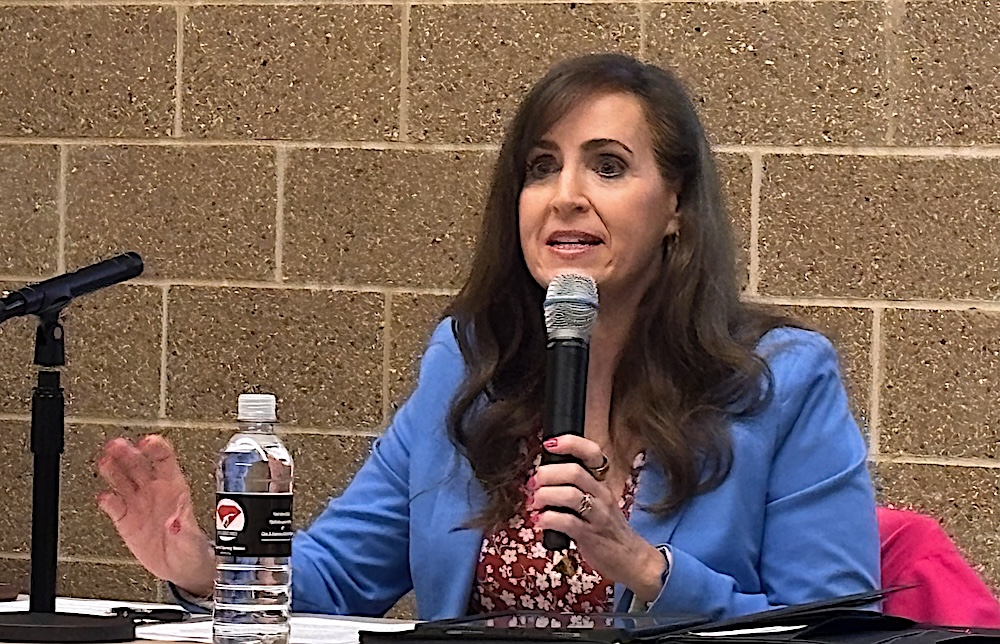
“We are leading the nation in developing a new program for a new licensed mental health professional,” she said. “According to a recent report, 75 out of the 88 counties in Ohio are designated as mental health professional shortage areas. We need to act to make sure that we are providing the resources and access to care that our citizens deserve.”
She said legislation creating a new licensed mental-health profession, the certified mental health assistant, is moving toward implementation. According to Gavarone, Northeast Ohio Medical University received approval for the program in January 2026 and began accepting applications for its first class, scheduled to begin in January 2027. The program is expected to take two years.
She also addressed administrative burdens facing health-care providers, citing Ohio’s ongoing review of occupational licensing rules and efforts to eliminate duplicative or unnecessary regulations. Gavarone said Ohio is also participating in numerous interstate occupational licensing compacts intended to help expand the state’s health-care workforce.
“We’ve been participating in a lot of occupational licensing compacts where you can accept people from other states. And in other compact states, people can go back and forth,” she said. “Hopefully, we’ll be able to build a workforce for people coming into Ohio.”
Currently, interstate occupational licensing compacts for psychologists, nurses, physical therapists, physicians, occupational therapists and counselors, audiologists, speech language pathologists, physician assistants, dental and dental hygienists, massage therapists, social workers, dietitians, school counselors, and respiratory therapists are intended to help expand the state’s health-care workforce.
School funding and property taxes
School funding generated a detailed exchange between the legislators.
Ghanbari, who supports the Cupp-Patterson Fair School Funding Plan, said the latest state budget brought approximately $11 million in additional funding to Wood County public schools.
Though he believes additional work is needed to fully implement the school funding plan, he would have preferred the most recent state budget to rely more heavily on the existing formula to provide additional funding for public schools.
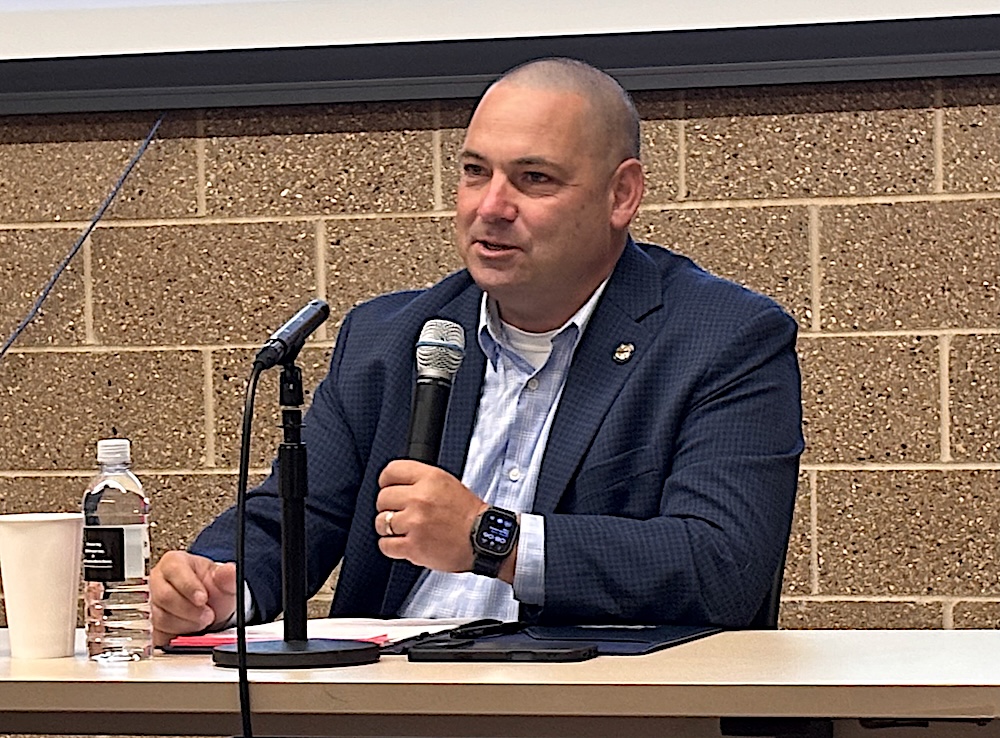
Gavarone approached the issue through the state’s property-tax system. She said House Bill 920, which was originally intended to prevent unvoted property-tax increases, had become complicated over time as changes were made to the law. She cited rising property valuations and the state’s 20-mill floor as factors contributing to higher property-tax bills.
What principles should guide the state’s allocation of education funding? And what policies would you support to ensure that public school districts have sufficient and predictable state support?
When asked by moderator Brandon Hemminger, “What principles should guide the state’s allocation of education funding,” Gavarone said, “I’ve got to say the overriding policy when it comes to education is making sure our kids get the best education possible. … Making sure that our kids are prepared for that next step in life, whether they’re continuing their education in college or university, or if they’re going into the workforce. We need to make sure that our kids have that education and background that they need going forward.”
She added that by putting more money into schools, “We need to make sure that we’re getting results.”
In the past budget, the state “had an additional payment that went to schools who performed at an exceptional level,” she said. “I think that’s something that’s important going forward,” citing the importance of using taxpayers’ dollars “in the most efficient way possible.”
Gavarone said five pieces of legislation were enacted to address property-tax concerns while maintaining resources for public schools. She cautioned that eliminating property taxes could have significant consequences for school funding.
A call for business-community partnerships
When asked what they would like northwest Ohio business leaders to work on with them over the next year, Gavarone and Ghanbari offered different but complementary priorities.
Gavarone called for stronger partnerships between businesses, school districts, colleges and universities to ensure students are receiving the skills employers need. She said aligning education with workforce demand benefits students, employers and the state’s economy.
Ghanbari called for civility and continued conversation within the community. He also emphasized the importance of skilled trades and agriculture, saying Wood County’s economic future should account for both business development and the preservation of productive farmland.
He advocated for locally developed strategic planning involving county commissioners, township trustees and other local officials to determine how Wood County should grow and position itself for future generations.
Both legislators also outlined additional legislation they hope to advance. Ghanbari highlighted continued work involving education, public safety, veterans and workforce development. He said he is entering his final elected term in the Ohio House and intends to remain focused on legislation that has a lasting impact beyond his time in office.
Gavarone discussed legislation involving domestic relations, funding for Educational Service Center facilities, driver’s licensing requirements for young people, school-bus safety, protections for election officials and expanded public access to a violent-offender database.
The discussion underscored a common theme throughout the Chamber’s legislative update: the importance of connecting state policy with the needs of local businesses, schools, workers and families while continuing to strengthen Northwest Ohio’s economic position.
Route 23 and regional economic growth
Both legislators also voiced strong support for improvements to the U.S. 23 corridor connecting Northwest Ohio with Interstate 71 and central Ohio.
Gavarone called the project a top priority and cited a study estimating a four-to-one return on investment. She said the preferred route could reduce peak travel times by more than 20 minutes and improve the movement of people and goods throughout the region.
Ghanbari said improved transportation would strengthen connections between northwest Ohio and other parts of the state, giving businesses better access to markets while making it easier for workers and residents to travel. He credited regional chambers and other organizations with helping build support for the project.
Looking ahead, Ghanbari said economic development will require a balance between attracting new businesses and managing growth. He identified shovel-ready development sites, brownfield redevelopment, affordable housing and access to health care as important components of a community’s ability to attract and retain employers and workers.
Gavarone similarly emphasized workforce development and talent retention. She said Ohio must continue developing training programs for in-demand jobs while creating communities where graduates want to remain.