By JULIE CARLE
BG Independent News
For more than half a century, five boxes of letters sat untouched.
They had belonged to Carole Sarkan’s parents, Jim and Bette Grabill, and remained boxed in the original envelopes in their garage until after her mother died in 2009. The boxes eventually moved into Sarkan’s garage, where they stayed for more than a decade.
Inside were roughly 2,500 letters penned by Jim, primarily during World War II, relaying his war stories to family and friends. Of those saved correspondences, approximately 1,200 were love letters from her father to the love of his life, before and after they were married.
Initially, Sarkan could not bring herself to read them—too many emotions and feelings tied up in those envelopes.
Then there was the cassette.
Years earlier, Sarkan had given her father a Sony tape recorder and encouraged him to record his stories. After his death, she found an unlabeled cassette in his cabinet. When she put it into the recorder, she heard her father’s voice.
“It was like he was right there,” Sarkan recalled.
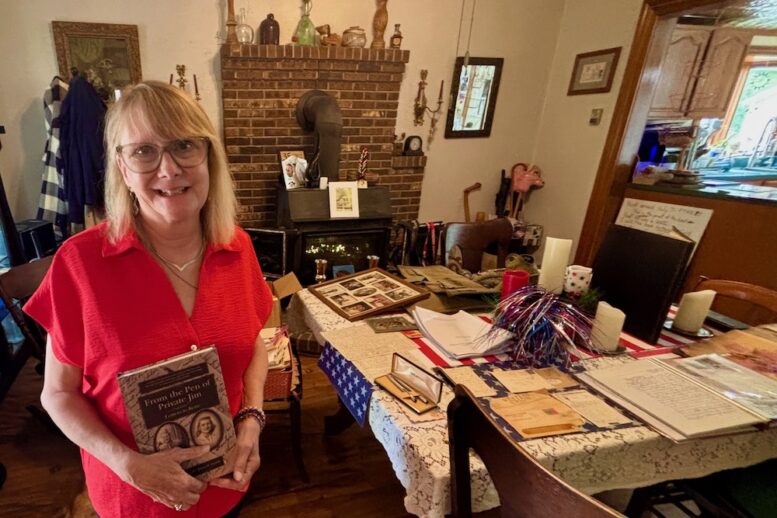
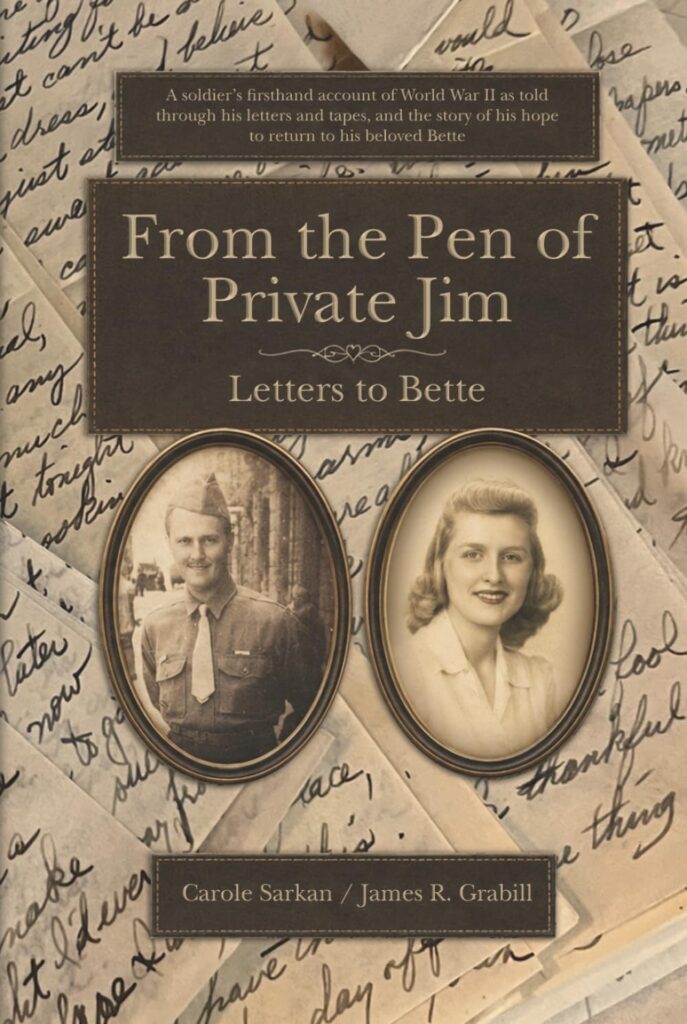
That discovery would eventually become the emotional foundation for “From the Pen of Private Jim: Letters to Bette,” a nonfiction historical book built around the letters of her father, then a young Army soldier separated from the woman he loved during some of the most dangerous years of World War II.
A love story born before the war
Jim and Bette met at Westerville, Ohio’s Otterbein College, where music brought them together. Jim, who played the violin, and whose father Glenn Grant Grabill led the college’s music department for 43 years; Bette played piano and accompanied Jim. Their relationship developed through music, correspondence and eventually courtship.
The letters revealed a young man uncertain about love at first, asking Bette whether she really loved him. Their correspondence eventually became more serious, and by 1943 they were discussing marriage.
They married Oct. 13, 1943, after he enlisted in the Army and returned on leave from bootcamp.
Two days later, Jim left for war.
From that point, the letters became a lifeline.
“He wrote from camps, foxholes and even latrines—sometimes twice a day,” Sarkan said. He asked why Bette had not written, requested candy and food, and filled the pages with the ordinary details of life thousands of miles from home.
For Sarkan, reading those letters was like discovering a version of her father she had never known.
Though he had always been a storyteller, the retired teacher and larger-than-life personality was suddenly a young soldier confronting fear, frustration, loneliness and uncertainty.
The soldier behind the letters
As Sarkan said, her father’s correspondence offers more than a love story.
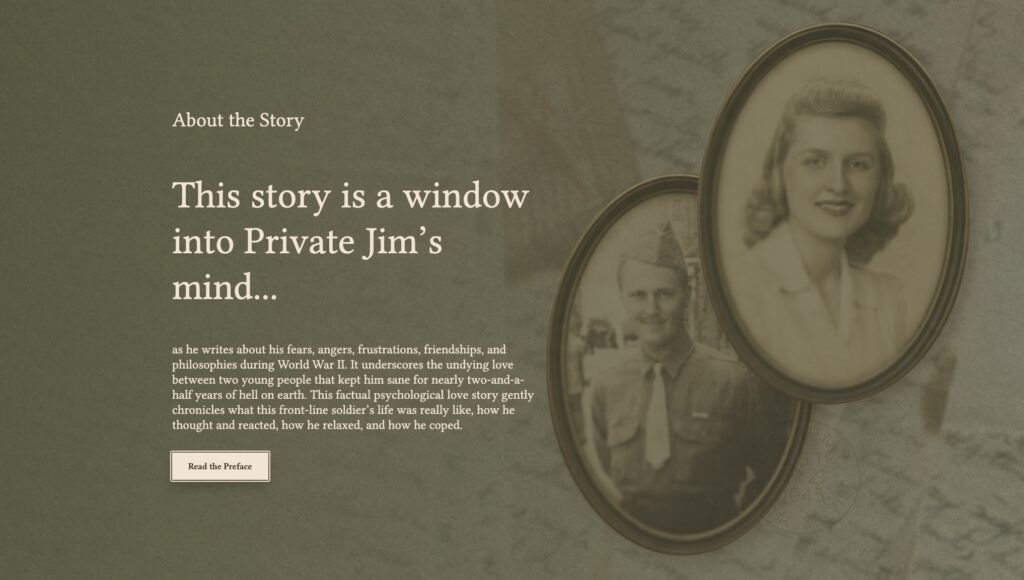
‘It provides a window into the mind of a frontline soldier—his fears, anger, frustrations, friendships, humor and philosophies,” she said. The letters chronicle the ways he coped with military life and the realities of war while holding onto his relationship with his beloved Bette.
He experienced the chaos of training at Camp Wheeler, where Sarkan said he witnessed the deaths of two friends. He eventually went overseas, first to Africa and then to Italy.
There, the realities of war became unavoidable.
Jim was wounded by shrapnel while sleeping in a tent. The injury struck his right arm, sending him to a hospital for two months of treatment and therapy. He later returned to combat and endured additional illness and hospitalization. He fought in five battles and ultimately received a Purple Heart, the African European Theater of Operations Campaign Ribbon with two battle stars, the Combat Infantry Badge and the Presidential Citation Unit Award.
Yet the letters did not always reveal the full danger he faced in part because he wanted to spare her the full details, but also because military censorship removed portions of his correspondence. Sarkan recalled opening letters and watching pieces of paper fall to the floor—sections cut away by censors. Jim often wrote that everything was fine, even when the reality was anything but.
Let Dad tell the story
Originally, Sarkan’s publisher expected her to write the story herself.
She tried, but it did not feel right. Sarkan knew her father needed to tell the story.
Her solution was unusual: she created a narrative in which Jim, years later, sits down in 1994 and opens his old letters, remembering what happened when he wrote them.
The approach allowed Sarkan to weave the original correspondence together with memories preserved on her father’s cassette recording and stories she had heard from him.
When she presented the publisher with three examples, the response changed everything.
“Do it.”
And so she did.
Sarkan wrote the book from her father’s perspective, advocating not only for her own vision but for her father’s voice to remain at the center of the story.
From 1,200 letters to one story
Sarkan ultimately selected 79 letters from the approximately 1,200 she discovered. Choosing them was difficult, she admitted.
The letters made her laugh and cry. Some made her angry. Others were boring. Some were emotionally overwhelming.
But together, they revealed the man behind the uniform.
Even the title came directly from Jim’s writing habits. He frequently referred to having his Sheaffer pen with him, and many of his letters began with references to his pen. When he lost it, he sometimes had to write in pencil—and he was not happy about it.
Thus, she determined “From the Pen of Private Jim” was the appropriate title.
And at its heart is a simple idea: let the soldier speak for himself.
A daughter’s way of bringing him home
For Sarkan, the book became much more than a publishing project.
While working through the letters, she often felt as though her father were beside her. At one point, she experienced four months of writer’s block. Then, after seeing the play “South Pacific,” the dam was broken; she went home, opened the letters again and began writing. Her husband, Mark, helped get through that writer’s block and helped edit her efforts. “He knew my dad so he could add things to it and make it flourish and make it just the most beautiful thing,” Sarkan said.
The process felt almost beyond her control.
“I don’t know how I did it,” she said. “It was like something else took over in me.”
The result is a story about war, but it is equally a story about memory, marriage and the extraordinary persistence of love.
Jim wanted Bette.
Again and again, amid the battles, hospitals, sickness and uncertainty, Sarkan found that what her father wanted most was to return home to the woman he loved.
More than 80 years after those letters were written, his daughter has given them another life.
And this time, she has made sure the voice telling the story sounds like his.
“From the Pen of Private Jim” is, in that sense, more than a collection of old wartime correspondence. It is a daughter handing her father the pen one more time.
The public is invited to Sarkan’s first official book launch Saturday, Aug. 22, from 1 to 4 p.m. at Simpson Garden Building, 1291 Conneaut Ave., Bowling Green. The book is available on Amazon and at other book retailers.
For more information about the book and Sarkan, visit the website at www.privatejim.com/.