By JULIE CARLE
BG Independent News
For the first 23 years of her life, Madi Stump-Smith never imagined she would run marathons, let alone ultramarathons.
Running simply wasn’t part of her life.
As a child, Stump-Smith struggled with severe ankle problems. As a middle schooler, she underwent four ankle surgeries over three years, including tendon reconstruction, and had implants placed in her ankle cavities to limit her range of motion. Even in high school, when she became more active through marching band, running remained painful.
A one-mile race she ran when she was 11 years old “was the longest I could go for the first 23 years of my life,” she said.
Now, the Bowling Green State University alumna and coordinator of external engagement for the BGSU Honors College is preparing for something that would have seemed impossible not all that long ago: a 218-mile ultramarathon through California’s Eastern Sierra.
On Oct. 2, Stump-Smith plans to take on the Mammoth 200, a multi-day mountain race with 31,000 feet of elevation gain and another 31,000 feet of elevation loss. The course averages about 8,100 feet in elevation and climbs above 11,000 feet twice.
She has 109 hours to finish. Her goal is to do it in fewer than 100.
The journey from a painful one-mile run to one of the most demanding endurance challenges of her life began with an unexpected medical breakthrough.
In summer 2022, after a weeklong backpacking trip in Maine left her struggling with ankle pain, Stump-Smith returned to the Michigan podiatrist who had performed her childhood surgeries. An exploratory procedure revealed that an implant in her left ankle had shifted and was rubbing against the surrounding area.
The implant was removed. Her doctor told her the foot had adapted to it after nearly 15 years.
About three weeks after the surgery, Stump-Smith ran a mile to see what would happen. “There was no pain,” she said.
That mile changed everything.
“Just the opportunities to see where my limits are — I think that’s what’s so exciting for me about ultra running,” she said.
Finding a trail
Stump-Smith admits her path to running was shaped in part by her time at BGSU.
She arrived at the university as a music performance major, drawn to BGSU’s stellar music program, honors college opportunities and campus community. But tendonitis in both hands made a professional career in music difficult, so she eventually changed her major to environmental policy.
She later fell in love with history and earned a master’s degree in the field from BGSU.
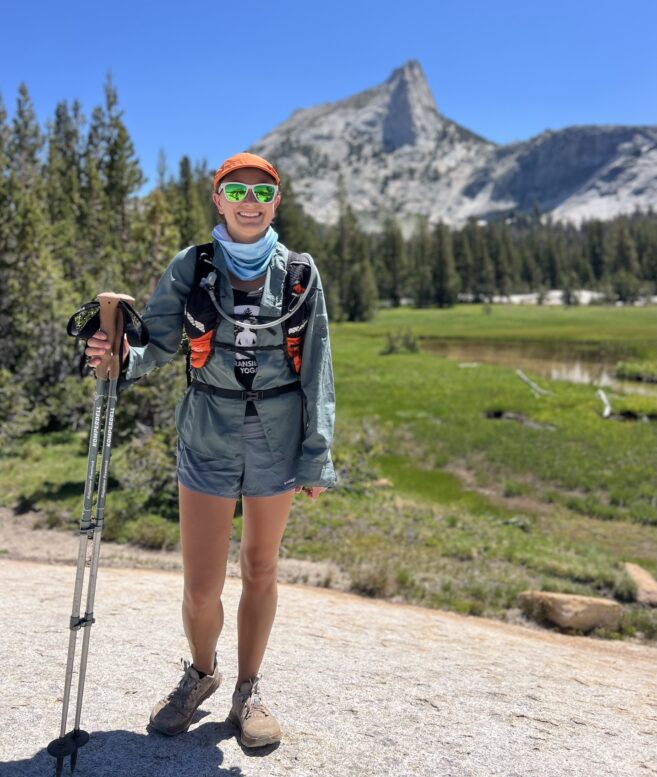
Inadvertently, her academic work also introduced her to another passion: the outdoors.
Through environmental policy, Stump-Smith became interested in backpacking and hiking and in the ways policy decisions influence people’s access to parks, green spaces and other natural places.
Her undergraduate years were filled with involvement. She worked in the C. Raymond Marvin Center for Leadership and Civic Engagement, participated in leadership programming and volunteering, conducted undergraduate research and completed projects through the Center for Undergraduate Research and Scholarship.
Her master’s thesis focused on local environmental history in the greater Bowling Green area.
“I developed these really strong feelings of community here,” she said.
After graduating with her bachelor’s degree in 2020 and getting married at the University Seal because of COVID restrictions, Stump-Smith and her Falcon Flame husband, Adam Smith, spent a year traveling around the country. They eventually returned to Bowling Green in fall 2021 for her graduate work, and she began working full time at BGSU in summer 2022.
Today, she is coordinator of external engagement for the BGSU Honors College, where she works with scholarship programs, communications, marketing and alumni engagement and advises students pursuing nationally competitive scholarships and fellowships.
And alongside that work, she has built an entirely different kind of résumé — one measured in miles, elevation and endurance.
Learning to go farther
Stump-Smith describes ultrarunning as both a physical and mental challenge.
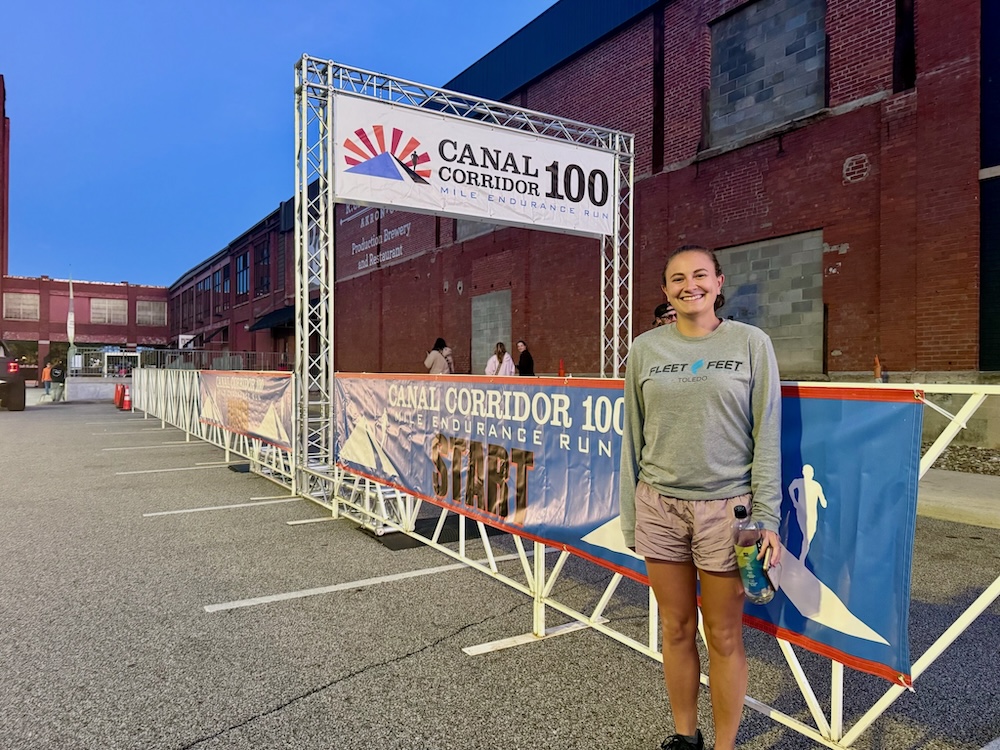
A 100-mile race, she explained, cannot be trained for by simply running 50 miles at a time. The physical demands would be too great. Instead, runners accumulate shorter training distances and prepare for the much larger challenge through nutrition, hydration, strength training and mental preparation.
“You have to make sure you’re eating and hydrating and staying awake all night,” she said. “That’s the mental game of ultras.”
She has already completed a 100-mile race, staying awake for about 30 hours from the time she got up to prepare until she finished.
The Mammoth 200 presents a different challenge because it is a multi-day race.
Rather than running continuously, Stump-Smith expects that sleep will become part of the strategy. She has been learning to listen to her body and adjust rather than rigidly follow a predetermined sleep schedule.
That philosophy extends to the race itself.
The Mammoth course is so long that thinking about all 218 miles at once would be overwhelming. Instead, Stump-Smith plans to break the course into manageable sections.
“There’s this massive climb to start, but it’s only about a seven-mile climb,” she said. “When I’m on that first climb, I don’t have to be thinking about the fact that I have to do this again in 200 miles. I’m just thinking about get to the top, get down, and then let’s problem solve for what’s to come next.”
Truly, it’s one step at a time, she added
Training for mountains in northwest Ohio
There is one obvious problem with preparing for a mountain race while living in northwest Ohio:
“It’s no secret that it’s flat,” Stump-Smith said with a smile.
To prepare for the Eastern Sierra, she spends considerable time on a treadmill with an incline and regularly runs the stairs at Doyt L. Perry Stadium. Every four to five weeks, she also travels to a mountainous area for a training camp.
One recent camp took her to Shenandoah National Park in Virginia, where she could spend a long weekend running mountain trails while her husband and their dogs stayed at a nearby campground.
Those trips are intentionally infrequent. Mountain training places significant stress on the body and requires recovery.
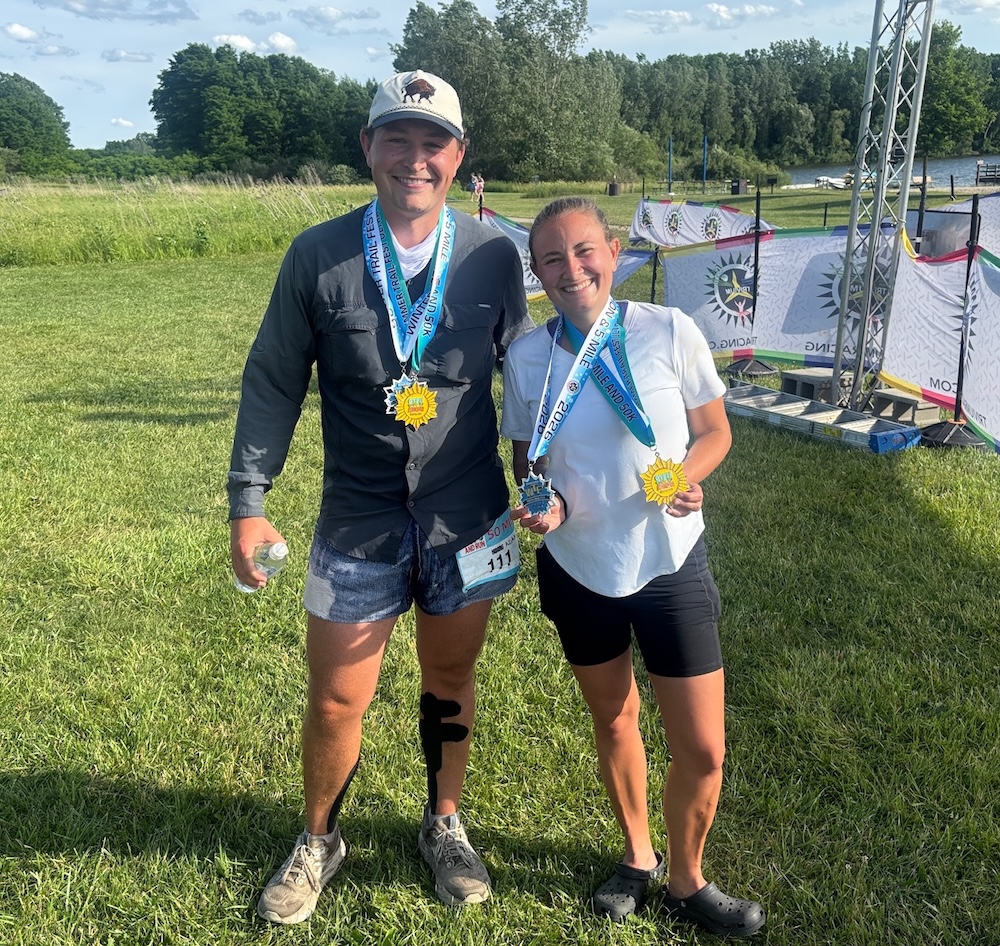
Most weeks, Stump-Smith runs six days, taking Mondays off. On weekends, she often completes 25- to 30-mile runs on both Saturday and Sunday. During the week, she adds shorter runs, strength training and time in the gym.
She also works with a running coach who specializes in supporting women who run ultramarathons.
The partnership is relatively new — about three months — but has become an important part of her preparation. Her coach programs the training, while the two discuss nutrition, aches and pains, running alone in the dark and the unique demands of a multi-day race.
A race measured in days
The Mammoth 200 will take Stump-Smith through the Eastern Sierra, southeast of Yosemite National Park.
The 218-mile loop follows the outside of a massive volcanic crater and travels through mountain communities and ranges in California. Much of the course consists of volcanic rock. The longest relatively flat stretch is only about 15 miles.
The race begins with a climb above 11,000 feet and ends with another climb up Mount Mammoth before the finish.
For someone who lives near sea level and trains primarily in flat northwest Ohio, the elevation is one of the race’s biggest unknowns.
Stump-Smith hasn’t had problems acclimating to elevation in the past, but she knows it has been a long time since she has spent significant time above 10,000 feet.
She cannot control the altitude, but she can control her attitude and what she eats and drinks, how she responds to fatigue and whether she listens to her body.
That distinction — between what can and cannot be controlled — has become central to her approach.
The race also requires extensive safety equipment. Stump-Smith will carry a 22-liter pack weighing about 8½ pounds, along with emergency gear, multiple headlamps, a raincoat, the ability to carry three liters of water, emergency food, batteries and a way to access the course map.
Running 218 miles is difficult enough. Running 218 miles with an eight-pound-plus backpack adds another dimension.
But Stump-Smith embraces that difficulty.
“I chose to sign up for this,” she said. “If I was unhappy about something, I shouldn’t have signed up.”
Running for something bigger
The Mammoth 200 is not simply a personal challenge for Stump-Smith.
She is using the race to raise money for Girls on the Run Northwest Ohio, an organization that uses running and movement to help girls build confidence, develop relationships and navigate challenges as they grow up.
Stump-Smith became familiar with the organization through her involvement as a volunteer coach with Fleet Feet Toledo, where she worked with runners preparing for distances ranging from their first 5K to half and full marathons.
She had not grown up participating in Girls on the Run. But the more she learned about its mission, the more closely it aligned with her own experience.
She wanted her Mammoth campaign to have a local impact, particularly for girls and women.
She hopes to raise $5,000 to support Girls on the Run Northwest Ohio. Those donations will support scholarships and running shoes for girls who otherwise might not be able to participate.
A website detailing Stump-Smith’s Mammoth 218 ultramarathon campaign (click here) has been established with links to support her Girls on the Run fundraiser and for potential partnerships.
For Stump-Smith, the connection with Girls on the Run is personal.
Running gave her a way to push beyond physical limitations she once thought would define her. Now she hopes her experience can encourage someone else to push through a barrier of their own.
“Maybe it’s running an ultra or my friend running her first marathon,” she said. “But maybe it’s related to breaking through a ceiling at work or in a personal life or some other societal challenge that people face.”
Her own challenge happens to be 218 miles long.
One mile at a time
Stump-Smith readily acknowledges that ultrarunning is uncomfortable.
She sees that discomfort as an opportunity.
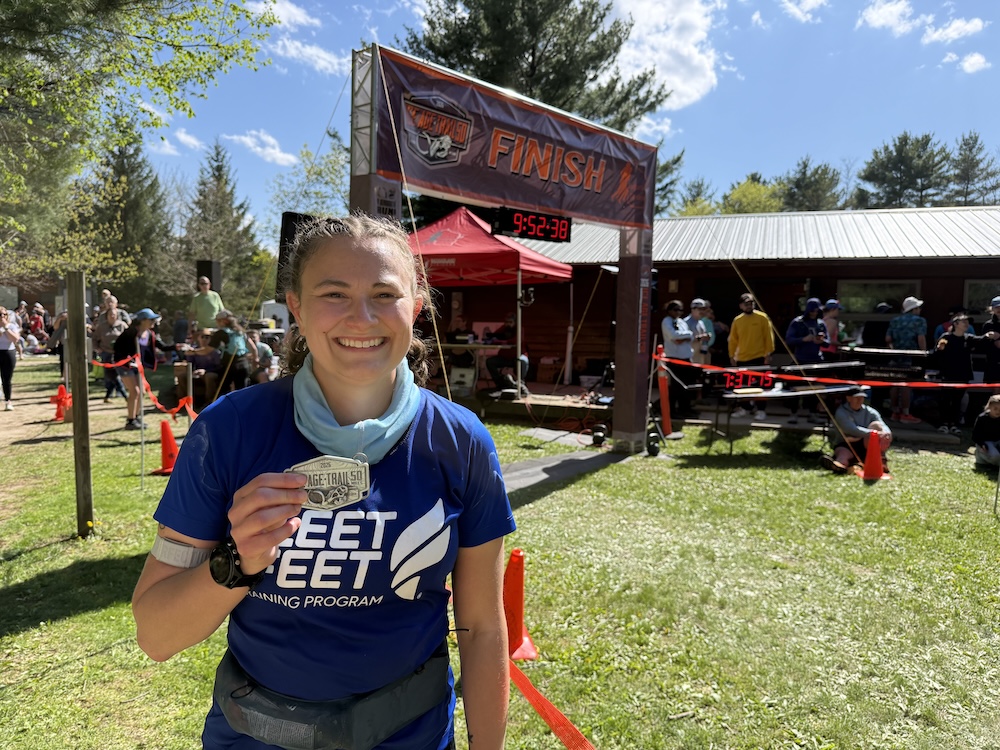
Always a high achiever who enjoys challenges, she said she has always found growth in being uncomfortable. Today, ultrarunning gives her a physical way to practice that philosophy.
The key, she says, is not to become overwhelmed by the size of the challenge.
She won’t think about running 218 miles. She’ll run the section in front of her. She’ll climb the mountain in front of her. She’ll eat, hydrate, rest when necessary, and solve the next problem.
“I’m going to keep going until it’s done,” she said.
For someone who once could barely run a mile, that mindset has already carried her a remarkably long way.
And when the clock starts at 9 a.m. on Oct. 2 in the Eastern Sierra, Stump-Smith will have 109 hours to find out just how far it can carry her.