By JULIE CARLE
BG Independent News
As farmers continue to face tighter profit margins and rising input costs, the Conservation Action Project continues researching ways to improve soil health while helping producers reduce their reliance on commercial fertilizers.
With support from H2Ohio funding, the nonprofit organization is working with farmers across seven counties to study conservation practices that could improve soil productivity, reduce fertilizer expenses and benefit water quality.
Alan Sundermeier, retired Wood County Extension Agriculture Agent who now leads the organization’s research efforts, said the goal is to demonstrate that practices focused on building soil health can make economic sense for farmers.
“Things are just getting tighter and tighter for farmers. The margins are getting smaller,” Sundermeier said. “We’re really trying to look for better ways to cut back on input costs and improve soil production so farmers can be economically viable still.”
One of the organization’s ongoing projects examines whether farmers can maintain crop yields while reducing phosphorus fertilizer applications.
The five-year study compares field plots receiving no phosphorus fertilizer with plots receiving farmers’ normal applications. So far, Sundermeier said researchers have not seen a yield disadvantage from withholding phosphorus, regardless of whether the soil initially tested high, medium or low in phosphorus.
The research is examining how healthy soil, active microbes, cover crops and reduced tillage can help make existing nutrients available to growing crops.
“If you have a healthy soil, you have microbes working, you have cover crops releasing nutrients and you’re not doing a lot of tillage or no-till, these things all help keep that phosphorus available that’s there in the soil to begin with,” he said.
CAP is also studying ways to reduce nitrogen fertilizer applications in corn production. One approach involves using cover crops, particularly legumes such as clover, to naturally contribute nitrogen to the soil.
Researchers have been studying reduced nitrogen applications for three years. Sundermeier said thus far, some trials have reduced nitrogen by approximately 30 pounds without negatively affecting yields or farm economics.
Establishing a good cover crop stand is important. For example, clover can be seeded into wheat and allowed to grow through the summer and into the following spring before the field is planted to corn. That extended growing period gives the clover more time to contribute nitrogen and organic matter to the soil.
The project is also investigating a practice known as planting green. Rather than terminating a cover crop well before planting, farmers plant corn directly into the living cover crop and terminate it at planting or after the corn begins emerging.
Researchers are comparing different termination dates to determine whether allowing cover crops to grow longer can increase nutrient availability and improve soil health.
The studies involve collecting plant samples for laboratory analysis and testing soil over time. Researchers are measuring nutrients, carbon and organic matter to better understand what cover crops contribute to the soil.
Newer soil-testing methods are another important part of the work, he said. The project is examining soil tests such as Solvita, which measures soil respiration, and POXC, which measures active carbon. Researchers are also using the Haney soil health test, which Sundermeier said provides information about nutrients that are more readily available to plant roots.
The Haney test costs approximately $60, compared with about $20 for a conventional soil test, making it more expensive to use regularly. However, Sundermeier believes the additional information can help farmers better understand soil health and make informed decisions about fertilizer applications.
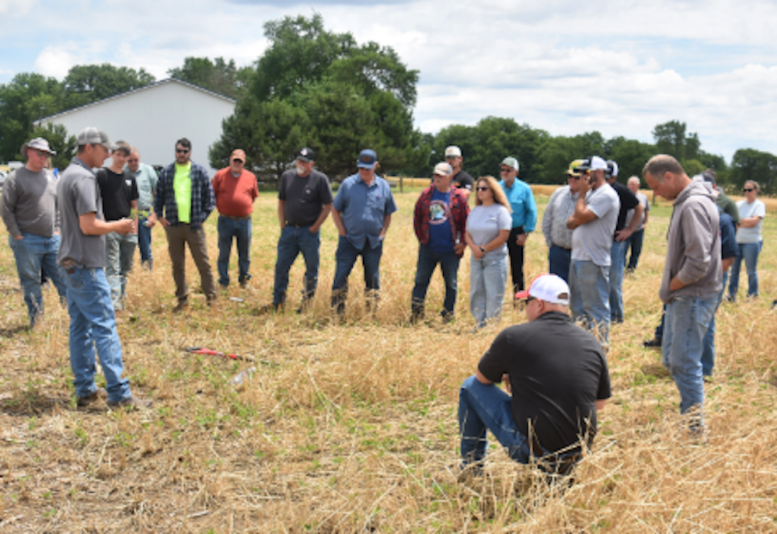
H2Ohio funding helps pay for much of the soil testing, while participating farmers receive a small payment for their involvement. The project has also received support through grants from the USDA and The Nature Conservancy. Cargill has helped through the Ohio No-Till Council with funding for meetings and educational efforts.
For Sundermeier, the research is about more than reducing fertilizer costs. It is also an opportunity to demonstrate the commitment many farmers have to protecting the soil and water.
“Farmers are not purposely over applying. They can’t afford to,” he said, noting that producers want to keep soil in place, protect water quality and improve their land for future generations.
He believes the public needs to recognize the efforts farmers are making to improve agricultural practices and maintain a reliable food supply.
Sundermeier also sees an important role for younger generations in agriculture. He encourages farm families to give younger producers opportunities to try new practices and participate in farm management decisions, even when those approaches involve some risk.
“If we’re not careful, this younger generation won’t want to continue in agriculture because of the frustration of that,” he said.
The Conservation Action Project continues to conduct field research, collect data and work directly with producers. Sundermeier said the ultimate goal is to provide farmers with practical information showing which conservation practices can improve soil health while making their operations more economically sustainable.
The research is ongoing, and Sundermeier emphasized that more data is needed before drawing firm conclusions about how much fertilizer farmers can reduce over time. But he believes demonstrating successful practices on working farms is one of the best ways to encourage wider adoption.