
By JULIE CARLE
BG Independent News
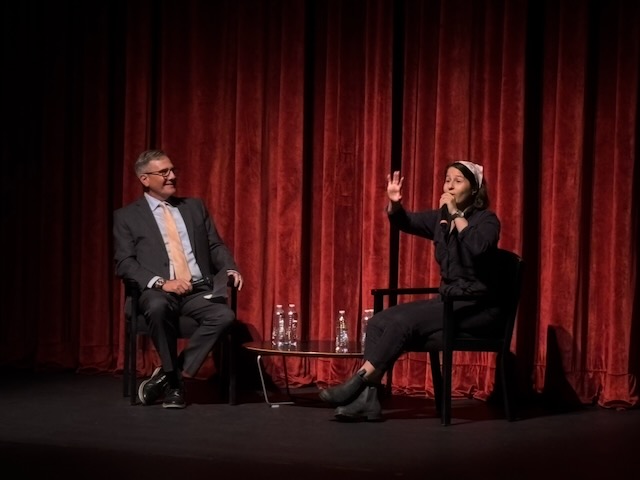
Shaina Taub brought the historical significance of her Tony Award-winning play “Suffs” to Bowling Green State University on Thursday.
She showed up at the 2026 Edwin H. Simmons Creative Minds lecture as her authentic, high-energy self, making the audience laugh and cheer. But mostly, she gave them reason to pause and reflect on the power of showing up, marching on, as did the women involved in the suffrage movement in the early 1900s.
The songwriter, performer, author and playwright spoke about her career, the creation of “Suffs,” and her belief that theater can connect audiences with history and inspire people to engage with their communities.
Her play “Suffs,” what the suffragists called themselves instead of he “diminutive term” suffragette, was born out of a question that she could not answer, she told the audience of students, faculty and staff, League of Women Voters members and community members.
When Rachel Sussman, a young producer, asked Taub what she knew about the American women’s suffrage movement, Taub admitted she knew very little. She was given suffragist Doris Stevens’ book “Jailed for Freedom” and began reading. What started as research soon became an all-night reading session—and eventually a decade-long journey toward Broadway.
She and producer Rachel Sussman first discussed the project when they were young and just beginning their careers. Taub said it took nearly a decade from their initial conversation to the show’s Broadway opening in 2024, a period that included the pandemic, setbacks and numerous rejections.
The historical research behind “Suffs” also changed the way Taub thought about the suffragists. She described being struck by the risks they took, including imprisonment, hunger strikes and other forms of resistance as they campaigned for voting rights.
Rather than create a story in which the audience could simply identify the “right” side of history, Taub said she wanted the musical to explore disagreements among people who shared a common goal.
“I wanted to try to make something less comfortable and hopefully more complicated,” she said. “Like, how do people who share a goal in theory have widely divergent ideas about how to achieve it?”
Further, she said the Suffs understood the power of visual rhetoric through pageantry, costumes, choreography, color and sound. In the days of black-and-white photography, the women strategically chose to wear all white so they would stand out in black-and-white photographs.
She became so excited about that perspective because “it was so theatrical,” she said. “I mean, what is a protest march if not theater?”
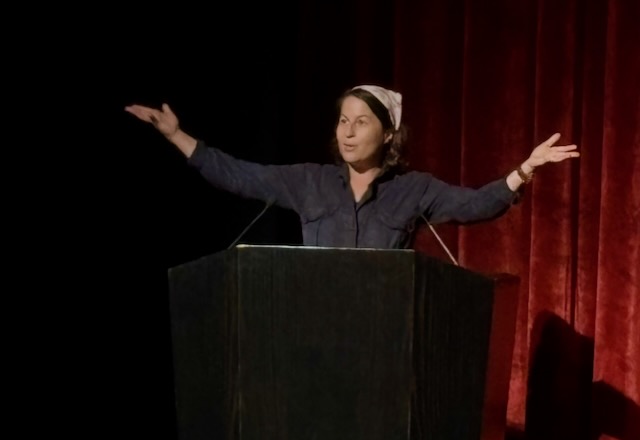
The complexity of the times became central to her approach to historical storytelling. Taub said she did not want to turn the suffragists into flawless heroes. Instead, she wanted audiences to see them as ordinary people who made mistakes, disagreed and struggled while attempting to create change.
“Real change has only ever been made, I think, by fallible, everyday people who take risks for what they believe in,” Taub said.
Theater provides a unique and ideal way to tell those stories because it brings people together in the same physical space. She described theaters as places where audiences can experience history, emotion and disagreement collectively.
A theater buff from a young age—especially musicals—she spoke about the importance of access to theater. Broadway tickets can be expensive, she said, limiting who gets to experience productions.
Because of her belief in the power of the theater, Taub has helped bring “Suffs” to schools, where students can participate both onstage and backstage. The production has provided grants allowing schools to perform the show free of charge, including schools in several states and one in Dublin, Ohio.
Taub’s BGSU appearance also had a personal connection. She told the audience that her father-in-law attended BGSU and graduated with the class of 1974. She said her family accompanied her to the event and that Ohio had become another home through years of visiting family.
Throughout her presentation, Taub returned to the idea that history is made by people who decide to participate, even when the outcome is uncertain. She pointed to the small groups of suffragists who demonstrated outside the White House and said their efforts illustrated how seemingly small actions can contribute to lasting historical change.
That is her hope with the play: that it helps people understand “that normal, imperfect people can still make a difference,” she said. “I hope it reminds us that ordinary, everyday people like us have made enormous progress before in what I think were even harder times.”
She encouraged BGSU students to think about what they care about and what they want to contribute through their own work, whether in the arts, activism or another field.
After her initial presentation, she sat at a piano and performed songs from the show. The songs she sang brought her joy, which she emphasized is an essential part of life. “Joy makes us feel good and powerful and strong and together,” she said, as she, again, connected the ability of music and art to sustain people through difficult periods.