By JAN McLAUGHLIN
BG Independent News
Across the nation, the proliferation of Flock cameras has communities debating the benefits to public safety and the risks of privacy rights. People on all parts of the political spectrum are voicing concerns about automatic license plate reader cameras.
But should drivers using public roadways have an expectation of privacy?
Bowling Green has 27 license plate cameras in the city. Images from the cameras have aided BGPD in solving hit-skip incidents, thefts, shootings, missing juvenile cases, and shopliftings.
The cameras take photos of passing vehicles, recognize license plates and vehicle identifiers, and store that information in a database. The software allows officers to search for vehicles and receive real-time alerts if they match vehicles sought by law enforcement.
Bowling Green Police Division believes it has found ways to use the technology to solve crimes, while taking steps to make sure the cameras aren’t being used improperly.
To begin with, BGPD is not using the Flock system, which is a huge network that can search for vehicles all across the country, according to Deputy Chief Adam Skaff.
Bowling Green uses cameras from Rekor, a smaller company, with an annual cost of $24,000 – less than half the cost of a Flock system, Skaff said.
While other cities are under fire for allowing wide searches of the images, BGPD has limited the access to camera images to two entities outside of BGPD – the Wood County Prosecutor’s Office and the Ohio State Patrol.
Skaff pulled up the camera audit for the past month, and noted that neither the patrol nor prosecutor’s office had accessed images in that period.
“We don’t share our data with anyone else,” unless they reach out with specific requests, Skaff said. That occurs occasionally, with the Wood County Sheriff’s Office checking for specific vehicles while investigating cases a couple times a month.
Within the BGPD, each time the Rekor database is searched for a plate, the officer has to log the reason justifying the search.
Unlike many other law enforcement agencies across the nation, BGPD does not have a contract that allows Immigration and Customs Enforcement to access the local images.
“We have never given access to anyone with ICE,” Skaff said. “It’s important to us to use it responsibly.”
Advocates say the cameras help quickly track down criminals, making cities safer.
Opponents say they’re a form of constant surveillance that infringes on residents’ civil liberties. Some critics have even turned to sabotaging the cameras.
Because Bowling Green owns its own electric system, the city’s cameras are posted on utility poles – which make them less vulnerable to vandalism. Unlike other communities that have seen their camera poles chopped off at the base, BG has not experienced any problems since they were installed four years ago.
“It shouldn’t be a mystery to anyone that we have them,” Skaff said of the license plate cameras. “We’re not trying to hide them.”
Bowling Green State University recently installed its first license plate cameras on campus.
“We look for opportunities to improve safety across campus,” BGSU Police Chief Mike Campbell said.
Shortly after they were put up, two of the five were destroyed.
Skaff noted that people tend to prioritize privacy, until they are victims of a crime themselves. The cameras have caught rape suspects, vehicles hitting pedestrians and bicyclists, illegal dumping, school bus violations, animal cruelty incidents, and responsible parties for fuel spills at gas stations.
The cameras have also proven helpful when police are conducting surveillance, or waiting for a suspect to return to the city so a warrant can be served.
“It’s finding that balance between public safety and privacy concerns,” Skaff said.
Just last week in BG, the license plate cameras helped solve a theft – with the stolen property being returned to the owner.
The city’s license plate cameras are limited to the entry points to the city, and main thoroughfares.
“If you get off the highway, your vehicle is going to get a hit,” Skaff said.
Most are posted along Main Street, Wooster Street, Poe Road, and in the downtown area. Skaff stressed there are no plate reading cameras in neighborhoods.
“There’s none in residential areas,” he said.
The cameras are limited in the images they can photograph. They can detect a vehicle’s color, make and license plate. The cameras cannot see faces inside the vehicle, and have no facial recognition technology, Skaff said.
The images are saved up to 90 days, and possibly more if they are needed for a court case.
“In my 24 years, I don’t know if there has been a piece of technology that’s been as beneficial to us,” Skaff said.
But he understands privacy concerns.
“I respect and understand why people are concerned about that. It’s healthy to have these discussions,” he said.
And BGPD is aware that no automatic license plate camera system is perfect.
“We have to double check everything,” Skaff said.
There are also concerns about some police officers misusing license plate reader data for personal reasons.
Several law enforcement officers have been disciplined for misusing data from Flock’s cameras, including an officer in Milwaukee who was criminally charged after using camera data to track someone he was dating and the person’s ex.
Three Arizona cities reported recently that they’re looking into officers’ use of the cameras, including one instance in which an officer is suspected of using them to track down his wife.
In Reynoldsburg, a suburb of Columbus, two officers resigned recently amid an investigation into misuse. An internal investigation revealed that one officer had used the technology more than 40 times to track down a former domestic partner.
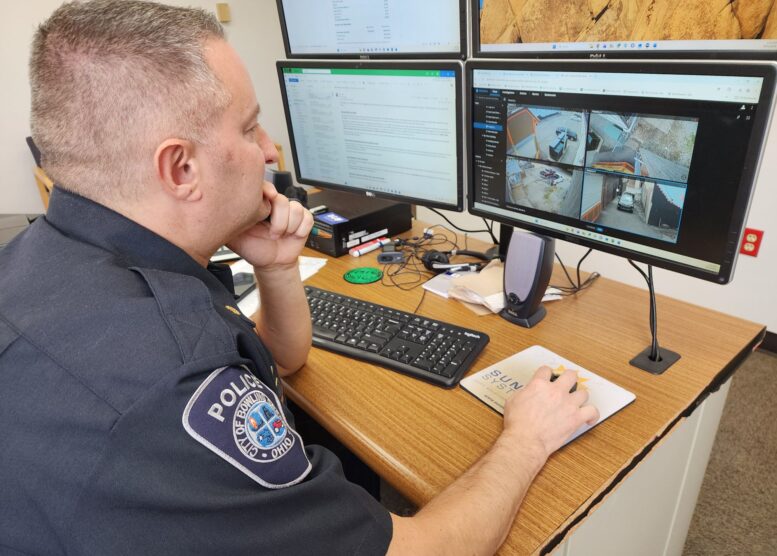
Bowling Green also has its own video cameras in the downtown area, focusing on the streets, sidewalks and city parking lots. The cameras capture views from about 50 angles in the downtown.
Police dispatchers aren’t focused on the camera footage, but can quickly pull up video if concerns are reported in a certain area.
That video is saved for about 30 to 40 days, depending on space limitations. That duration is necessary in cases that don’t get reported immediately, Skaff said.
“It’s important for us to look back,” he said.