By JULIE CARLE
BG Independent News
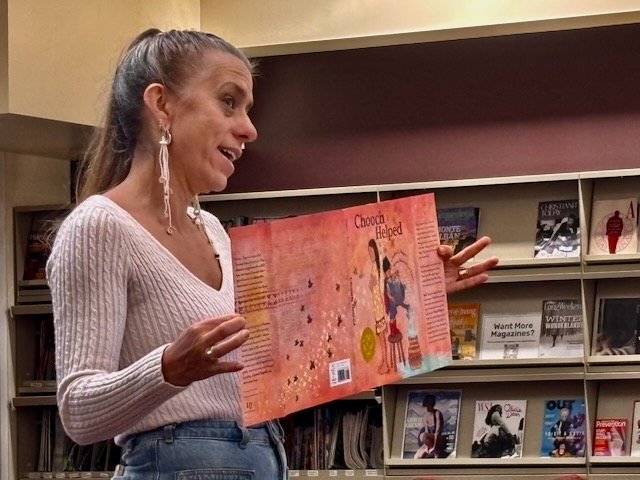
Rebecca Lee Kunz remembers spending many hours poring over picture books with her children when they were young.
“My favorite time of the day was crawling in bed with the kids and a stack of books,” Kunz recalled during a recent talk at the Wood County District Public Library. She was one of the guest speakers for the 2026-27 “In the Round” speaker series, a long-running collaboration between Bowling Green State University and the library featuring Native American and First Nations artists.
Now, as a children’s book illustrator, Kunz said she has “really enjoyed learning more about the other side of books, of being a maker of books.”
BGSU and the library welcomed Kunz, a citizen of the Cherokee Nation of Oklahoma, to share her art, storytelling and Cherokee culture with the university and Bowling Green area communities.
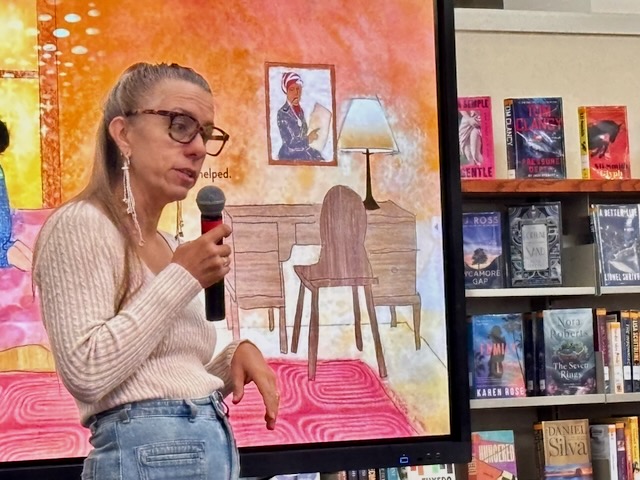
She spoke about her work as an illustrator, artist, business owner and mother. Her work crosses several artistic forms, including painting, printmaking and illustration.
One of the books at the center of her presentation was “Chooch Helped,” written by Andrea L. Rogers and illustrated by Kunz.
Kunz explained that creating a picture book is a collaborative process involving an author, publisher, editor, art director and illustrator. Her first picture-book illustration project required her to create artwork for a 32-page story while keeping the characters and visual world consistent throughout the book.
Her approach to picture books goes beyond simply creating attractive images. “It’s very different from making art for yourself, a drawing or a card for my best friend’s birthday,” she said. Instead, she becomes a visual storyteller whose job is to tell a story through pictures, even imagining that the words on a page do not exist.
“I have to very thoroughly tell a story just through images,” she said. “That’s a big job, and it’s very fun, like trying to solve a mystery or trying to figure out all the puzzle pieces that go into telling the story.”
For Kunz, the illustrations also provide another layer of storytelling. She intentionally incorporates symbols, patterns and visual clues, including what she calls “Easter eggs,” to give readers additional ways to understand the story.
Patterns in her artwork draw inspiration from historical Native American artwork and pottery, including motifs associated with Moundville.
The book’s back matter also includes additional material such as directions for making a clay pinch pot and details about the Cherokee syllabary, “like an alphabet, a system for decoding our language,” Kunz explained.
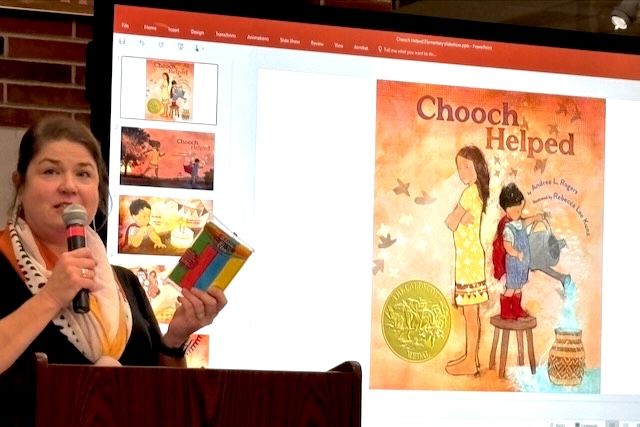
Kunz also discussed the importance of accurately representing contemporary Cherokee life.
Often, when people think of Native Americans, they think of someone in a headdress. “My people never wore headdresses; we never had stomp dances or powwows,” she said. “Every tribe in the U.S. has different practices and beliefs and they look different,” which is why the author wanted to make “Chooch Helped” an honest story about what Cherokee people look like today.
The illustrations in the book are filled with symbolism. Butterflies, for example, represent transformation as the characters move from anger and sadness toward apology and reconciliation. Green footprints provide another visual clue, connecting the story’s present events to the character’s childhood.
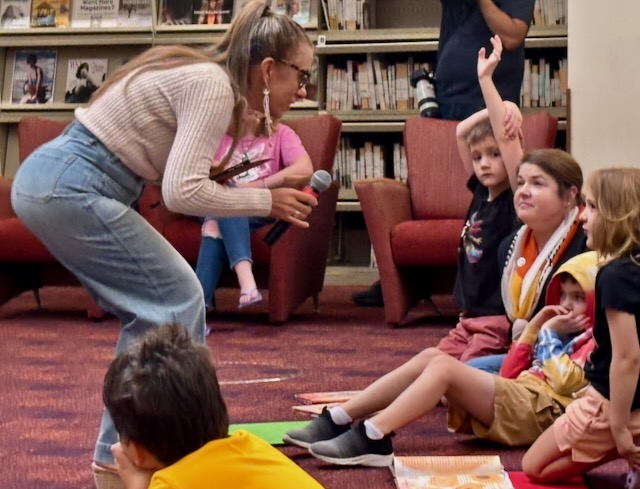
The hard book cover is different from the book jacket. “I got to design a really fun cover, using some of the designs and motifs from the book,” she said. “This is another place where I got to make art and got to make some choices about what to put here and how to decorate this.”
Kunz said she created the artwork using mixed media, combining watercolor, drawing, painting and digital work. Although she had considerable creative freedom, she also worked closely with an art director who provided guidance throughout the process.
Her presentation also offered a glimpse into a more personal project: “Ruth Muskrat and the So-Called Indian Problem.” The nonfiction picture book, written by Kunz’s sister Jen Loren and illustrated by Kunz, tells the story of their great-great-aunt, Ruth Muskrat, a Cherokee writer, poet, educator and activist. Kunz described Muskrat as an important influence on Native American advocacy and noted that she was among the founding members of the National Congress of American Indians.
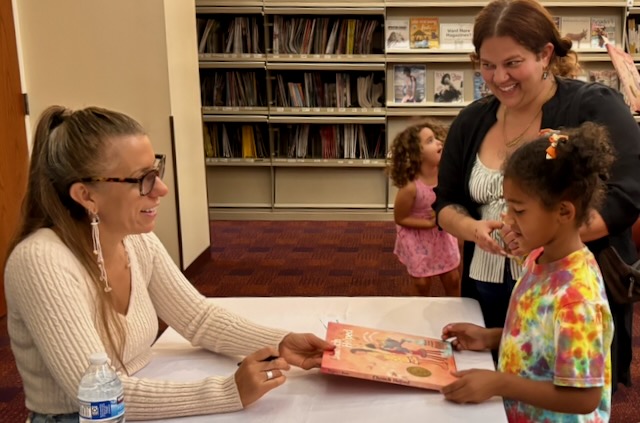
The project was especially meaningful to Kunz because it connected her professional work with her own family history. She said the book took more than two years to create because of the amount of historical information involved. Muskrat’s life unfolded during a period of major change for Native Americans in Oklahoma, and those experiences shaped her later commitment to improving the lives of Native people.
The book’s official release date is Oct. 6, but the library event had early copies of the book, made available through the Mazza Museum.