By JULIE CARLE
BG Independent News
For poet Maggie Smith, a finished book is never quite finished.
The poems may be bound between hard covers, the manuscript may have gone through countless revisions, and the book may finally sit on a bookstore shelf. But Smith told a Bowling Green State University audience that writing—and the person doing the writing—is always changing.
“We’re constantly later, more revised drafts of the people we were last week and last year,” Smith said during her recent BGSU appearance. “I won’t say better. I’m not here to optimize. I’m a poet. I don’t need to be better, but I expect to be different.”
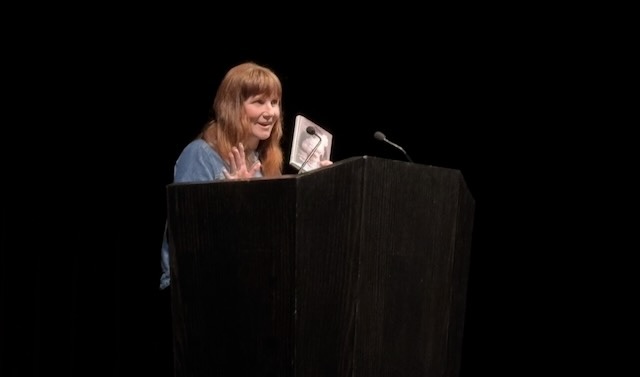
That idea of the self as an evolving draft became one of the central themes of Smith’s visit, which brought the Ohio poet to campus for a reading and conversation with students, faculty and community members.
Smith, perhaps best known for her widely read poem “Good Bones,” read from her newest poetry collection, “A Suit or a Suitcase,” and discussed the process behind the book. She also answered questions from the audience about finding a voice, handling rejection, knowing when a poem is finished and assembling a collection.
The evening began with BGSU’s celebration of poetry itself. Amorak Huey, director of creative writing, welcomed the audience and appreciated the university’s continuing support for the arts.
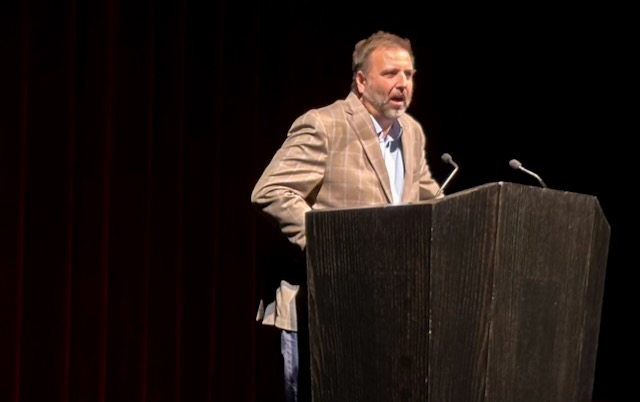
He noted the importance of being able “to gather in the name of poetry, because the world doesn’t really care about poetry, except when they do,” he said. “We turn to poetry when we need it. … We think it’s not important and then we come to these moments in our lives, these pivotal moments of grief, love, loss … and we turn to poetry every time.”
As Gayle Castle, a creative writing graduate student, introduced Smith, she described encountering the poet’s work as a turning point in her own development as a writer. For Castle, Smith’s poems offered a different way of seeing the world and explored family, spirituality, nature and life in Ohio.
Smith responded with characteristic humor and humility.
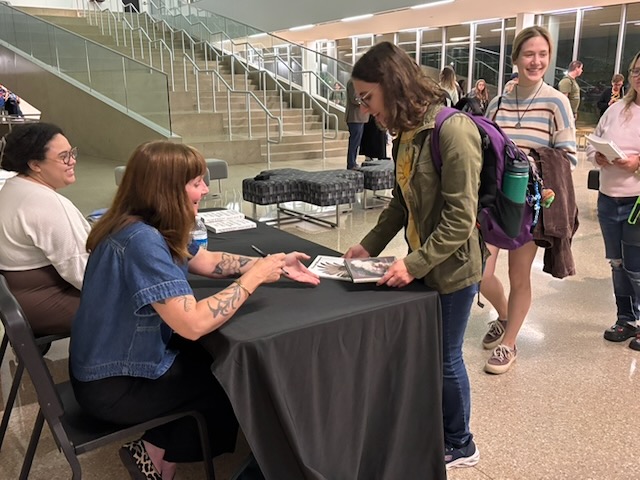
After hearing her biography—which included books, awards, fellowships and the international reach of “Good Bones”—she reminded the students in the room that a biography tells only part of a writer’s story.
“If I had a bio that was like the part of the iceberg underneath the water,” Smith said, “every rejection I got from the literary magazine or press, every fellowship I applied for and didn’t get, every grant I wanted and they said no to me, it would be so long she would still be reading it right now.”
For Smith, rejection is not simply an unpleasant part of writing. Sometimes, she said, it can redirect a career.
She recalled submitting “Good Bones” to respected print magazines after finishing the poem. Several rejected it. Smith eventually sent the poem to Waxwing, a small online journal that had recently launched.
“That little journal” changed her life, she said.
Had one of the larger magazines accepted the poem, Smith said, it might have felt like a major accomplishment at the time. But the poem might not have reached the audience it ultimately found.
“I like to remind myself of that when I’m told ‘No,’” Smith said. “Because sometimes it stings and I like to tell myself it’s widening the aperture.”
Smith’s advice about writing was similarly grounded in observation rather than formulas.
When a student asked how to use descriptive language without making writing feel forced or overly “flowery,” Smith compared excessive figurative language to over-accessorizing an outfit. Sensory details should not feel like decorations added after the fact. They should be part of the sentence itself.
Her “invitation” to a solution: “Just observe small things. Don’t try to write a poem. That’s a terrifying prospect. I would never walk into a room and say, ‘Write a poem,’” she said. “But I could walk into a room and say, ’Can you find something in this room worth describing well in three sentences?’”
Consider “the constellation of freckles on the person’s hand who’s sitting next to you or something about the quality of light,” she said, adding that it could be a sound, a smell or a feeling.
“And if you can write two or three sentences that gets at something concrete, you’re like a third of the way to a poem without being blunt,” she said.
That attention to ordinary details is evident in “A Suit or a Suitcase,” whose title poem considers the relationship between the body, identity and the passage of time. Smith also read poems exploring memory, aging, motherhood and the shifting versions of ourselves that exist across a lifetime.
One of the collection’s major themes, she explained, emerged only after she had assembled the poems. She described the experience as painting a canvas with her nose an inch from the surface—working on one small area without knowing exactly what the whole picture will become.
Only afterward, when the poems are gathered together, can she step back and see what she has been making.
Smith applies a similar philosophy to the books themselves. She described assembling a poetry collection like making a mixtape. She prints out the poems she has written since her previous book—sometimes 100 or 150 of them—and begins sorting.
First come the poems she does not like. Then she looks for connections among the ones that remain: tone, imagery and theme. She finds an opening poem and considers what poem should follow it based on the feeling and image left by the previous poem.
“There is no right way,” she said of the process. “It’s just whatever gets you there. That’s the right way.”
That openness extends to her relationship with older work. Smith said she sometimes reads poems she published years ago and wishes she had made different choices. But she does not believe in rewriting them.
Instead, each book becomes a kind of time capsule—a record of the writer she was when she created it.
She recalled her first book, published when she was 28, and said she would not write those poems the same way today. But changing them now, she said, would mean unfairly applying her current knowledge to her younger self.
“I have to respect the person who built them,” she said.
For Smith, recognizing what she would do differently is not necessarily a sign that the earlier work failed. It can be evidence of growth.
The same philosophy appears in her newest poems, which repeatedly return to questions of memory, identity and the future. In one poem, Smith imagines future versions of herself looking back at earlier versions, each one unfinished but preserved.
The image also captures something essential about Smith’s approach to writing: nothing has to be the final version.
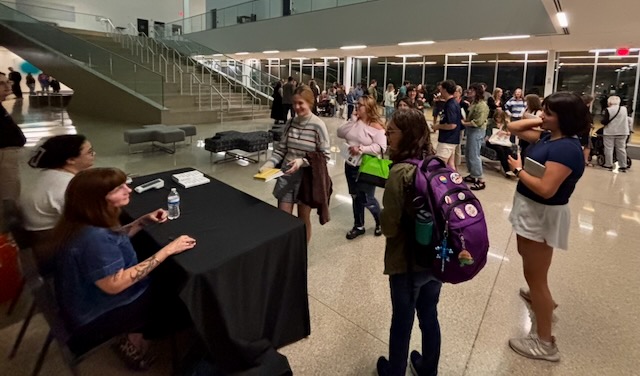
Even a book is provisional. Even a poem is a record of a particular moment. And even the writer is still becoming.
Near the end of the evening, a student asked what Smith would tell herself at 28, when she was publishing her first book.
Her answer was less about literary success than perspective.
“Take a deep breath, calm down,” Smith said. “This is very low stakes and you’re playing the long game.”
Publishing a book, she explained, can change a writer’s life while leaving much of everyday life exactly as it was. There are still dogs to walk and laundry to do. There will also be other books, other opportunities and other chances to put something into the world.
“You’re going to have other chances,” she said. “This isn’t the only time you’re going to get to put something into the world.”