
By JULIE CARLE
BG Independent News
Artificial intelligence seems to be everywhere; it is even becoming part of the legal landscape. But three Wood County Common Pleas Court judges are adamant their final rulings are made by humans, not AI.
The technology comes with an important requirement: everything it produces must be checked by a human.
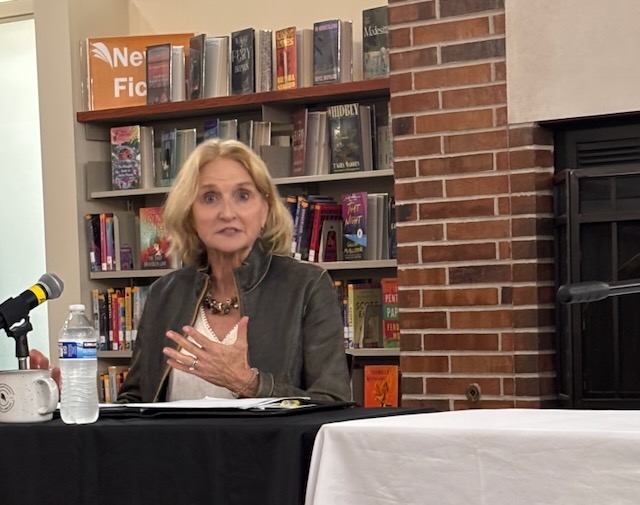
On Tuesday, Judges Molly Mack, Joel Kuhlman and Matthew Reger discussed the growing use of artificial intelligence during a special program hosted by the Wood County Law Library and Wood County District Public Library. The event was held as a memorial lecture honoring the life, service and memory of the late Dennis East, a longtime member of the Wood County Law Library Resources Board.
The judges described AI as a potentially useful tool for legal research, document preparation and reviewing large amounts of information. But they also described cases in which AI-generated filings contained nonexistent cases, inaccurate citations or legal arguments that did not fit the circumstances of a case.
Mack said the court has access to AI through a closed legal research system and that she uses it as an assistant to help begin research.
“If there are citations that come up in some of the research that we do, we need to review those and make sure that the citation is correct,” she said.
That need to verify information was a recurring theme throughout the discussion.

Kuhlman said generative AI has changed the appearance of filings from people representing themselves without attorneys.
“When I became judge, I was getting a brief or a pleading from somebody that doesn’t have an attorney; it was handwritten,” he said, wondering why they didn’t have someone type it. “Now, with generative AI, we are getting 30- or 40-page documents from people that are unrepresented by attorneys.”
The documents may be organized and look professional, but “it might not make any sense,” he said. “It makes it more difficult to determine what arguments actually need to be addressed.”
The problem becomes particularly serious when AI creates what Kuhlman referred to as “hallucination” —a case that looks like it exists because it is cited in a brief, but it doesn’t actually exist. Additionally, a hallucination can be a real case that is incorrectly applied, or a quotation attributed to a court decision that never actually appeared in the decision, he explained.
Reger said the courts have already encountered situations involving questionable AI-generated material.
In one example discussed during the program, a filing was struck from the record because it did not comply with the court’s local rules, which the common pleas courts adopted earlier this year, Mack said. The judges emphasized that attorneys and people representing themselves are responsible for the accuracy of what they submit.
The consequences can extend beyond having a filing rejected. Mack said attorneys have ethical obligations to ensure that information submitted to a court is accurate, and violations can potentially result in sanctions or disciplinary proceedings.
At the same time, AI can provide meaningful benefits, particularly for people who cannot afford an attorney.

Reger described AI as a resource that can help a self-represented litigant understand legal terminology, organize information and format a filing. But he stressed that AI cannot replace the advice and judgment of an attorney.
AI has the potential to make some aspects of litigation more efficient.
Kuhlman said discovery — the process through which parties exchange and review information and documents — may be one area where AI could have a significant impact. Civil cases can involve thousands of pages of documents, and properly used AI could help attorneys locate relevant information more quickly.
Reger cautioned, however, that greater efficiency does not necessarily mean courts will simply dispose of cases faster.
AI could also create additional work if attorneys and judges have to spend significant amounts of time checking AI-generated material for accuracy.
Wood County courts are already taking steps to establish rules for the technology.
Mack said the Wood County Common Pleas Court adopted a local administrative rule concerning the use of AI and generative AI earlier this year. She also said the Sixth District Court of Appeals, which handles appeals from Wood County, adopted a local rule that Wood County followed.
The judges also pointed to guidance from Ohio’s disciplinary authorities concerning the use of AI by judges and attorneys.
Another concern discussed was the growing ability of AI to create or alter photographs, audio and video.
Reger said courts will have to pay close attention to the authenticity of digital evidence as AI-generated material becomes increasingly difficult to distinguish from genuine recordings or images.
Traditional rules governing evidence still apply. A photograph, recording or other piece of evidence must still meet the requirements for admission into court.
Despite the rapid development of the technology, each of the judges was clear about one boundary they do not expect AI to cross: deciding cases.
Mack said judges are elected to decide disputes and that responsibility will remain with human judges.
“We sit here as the judges of your county, and we are elected to decide matters. We are elected based on our perceived judicial temperament and our job is to decide disputes,” she emphasized. “We are not going to give that responsibility to a tool. So regardless of where AI goes and how the court uses it, that judgment, that final decision on your case or your neighbor’s case will be decided by a human being elected by people.”