By JAN McLAUGHLIN
BG Independent News
Bowling Green residents are being asked to hang up their car keys for a week, put on their walking shoes, pedal their bikes, or carpool to their destinations.
Multiple local agencies are teaming up together to encourage the public to participate in the “Week Without Driving,” from Oct. 1 to 8.
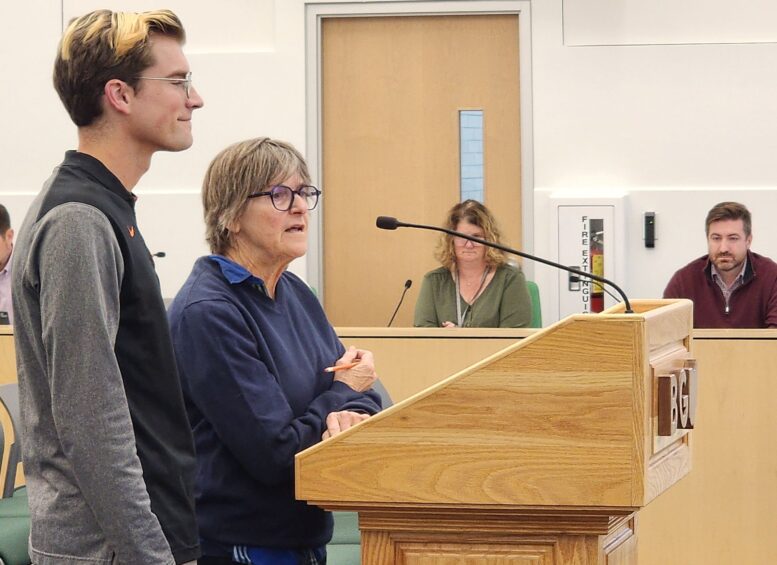
An estimated 30% of the U.S. population does not drive cars, Rose Drain of BG Save Our Neighborhoods Group told Bowling Green City Council last week. The reasons vary, from not being able to afford a vehicle, gas or insurance, to being too young or too old, or having a disability.
The purpose of the Week Without Driving is to highlight the need for safe transportation for the non-drivers present in every community.
“We want to increase awareness of folks in our community who cannot drive or who choose to get around in a different way,” Drain said.
The event is part of an annual nationwide project.
“We’re part of a national effort and it feels pretty good to be part of this,” Drain said.
One of the people helping to organize the local Week Without Driving is Bowling Green resident Debbie Thompson, who uses a wheelchair or BG Transit to get around town. She is hoping local residents participate however they are able.
Participants don’t have to give up driving for the entire week, but can join in however it fits in their lives, she said.
“Maybe they can walk uptown to dinner, or walk to the post office,” Thompson said.
“We want to show people that it’s a responsible thing to do,” she said. Any efforts to reduce driving also reduces traffic and emissions.
“And it’s going to show people what we face,” Thompson said of people in the community who don’t drive.
Zach Hayes, of the Bowling Green State University sustainability office, encouraged City Council and local residents to pledge to participate in the week. The pledge highlights other forms of transportation like walking, taking public transit, carpooling, or riding a bike, scooter or skateboard. Community members can participate by signing the pledge available here: https://www.bgsu.edu/campus-sustainability/transportation.html.
Partnering to bring the Week Without Driving to Wood County are the following organizations: Wood County WorkLink, Wood County Hospital, Wood County Health Department, Bowling Green State University Campus Sustainability, Bowling Green Save Our Neighborhoods Group, and the city of Bowling Green Bicycle Safety Commission.
To celebrate local participation in a Week Without Driving – and to hear personal stories from participants – the community is invited to the wrap-up celebration on Thursday, Oct. 8, at 6 p.m., at Wooster Green, 100 S. Church St., Bowling Green. This celebration will include pizza and a prize drawing for all those who made the pledge. The rain location will be First Presbyterian Church of Bowling Green, 126 S. Church St.
According to national groups of Nondrivers Alliance and America Walks, most communities are built around the assumption that everyone drives – despite the fact that nearly one third don’t. Week Without Driving challenges this narrative, highlighting the stories and experiences of nondrivers.
The week is intended to help motorists imagine their lives without driving – navigating daily routines, reaching workplaces, doctors’ offices, or connecting with loved ones.
Now in its sixth year, Week Without Driving has grown to include more than 800 cohosting organizations across all 50 U.S. states, Canada and Australia.
For people who can grab their keys and go, transportation often isn’t a major concern. But for those who can’t drive or can’t afford to, transportation is a daily dilemma.
Whether for a single trip, for a day or for the entire week, people are asked to try to rely on riding a public transit, walking, biking/scooting or asking for rides to understand what it takes to get places without driving.
“We care about accessibility because it can make the difference between getting to do the things that connect us to our communities, like running errands, seeing a friend, or getting to an appointment — or being stuck at home and isolated,” stated the Nondrivers Alliance website.
“We’re largely invisible – more often measured in absence. We are the people who didn’t make it out from wildfires or flash floods, who missed our doctors or court appointments because the bus never showed up. We are the parent that couldn’t get to the school play and the kid who couldn’t sign up for the soccer team because there just wasn’t a good way to get there,” according to Nondrivers Alliance.
“We ask participants to ride the bus, walk, scoot, bike or ask for rides during the week to better understand the gaps that exist and why we need to invest to make our communities more accessible,” Nondrivers Alliance noted.