By JULIE CARLE
BG Independent News
For Alex and Justine Wallace, life changed almost immediately after their son Lincoln was born in November 2025.
What began with a routine prenatal ultrasound became an emergency. Doctors discovered fluid affecting Lincoln’s lung, and within two days, Justine underwent an emergency C-section on Thanksgiving, and for the next 49 days, that sweet little boy was cared for in the neonatal intensive care unit.
At first, doctors knew something was wrong, but they did not know exactly what or why.
Lincoln could not come off oxygen. He could not visually track objects. Testing repeatedly returned abnormal results. He developed diabetes insipidus—which impacts the ability to balance fluids instead of blood sugar levels.
His doctors began looking for a genetic explanation. Eventually, after other testing failed to provide answers, a genetics team in Cincinnati identified a rare KCNQ2 gain-of-function variant.
According to Alex, Lincoln is only the 12th person ever diagnosed with the variant in North America.
The rarity of the condition has made Lincoln’s medical journey unlike anything his family could have anticipated.
“With KCNQ2, there’s two kinds. There’s gains of function, loss of function,” Alex explained “He has the gains, and he starts off fine. The older he gets, the more aggressive it gets.”
The prognosis has been devastating. Alex said the oldest known person with Lincoln’s particular variant lived to age five, while the average survival he has been told is between six and 18 months. Specialists in several cities have also told the family that research funding for such an extremely rare condition is difficult to obtain.
The Wallaces have traveled to specialists in places including Philadelphia, Cincinnati, Dayton and Boston. Again and again, they have heard the same message: because so few children are known to have the condition, there is little research funding available.
For a parent, accepting that reality is not simple.
“You don’t at first,” Alex said when asked how the family manages the diagnosis. “At first it’s just like a fog.”
Eventually, the family began concentrating on what they could control: Lincoln’s comfort, his quality of life and the needs of the rest of their family.
Learning what hospice can mean
One of the most important discoveries for the Wallaces was that hospice care did not necessarily mean giving up.
The family initially associated hospice exclusively with the end of life. Instead, they found an organization focused on helping Lincoln live as comfortably and meaningfully as possible.
Lincoln receives support from Hospice of Northwest Ohio, including a dedicated nurse who visits regularly, as well as a hospice physician and nurse practitioner.
“We are there to give quality of life,” Alex said, describing what the family learned about pediatric hospice. “With children, they do quality and then when it turns into the end of life, they’re there as well.”
The support has become an important part of the family’s resources and medical network.
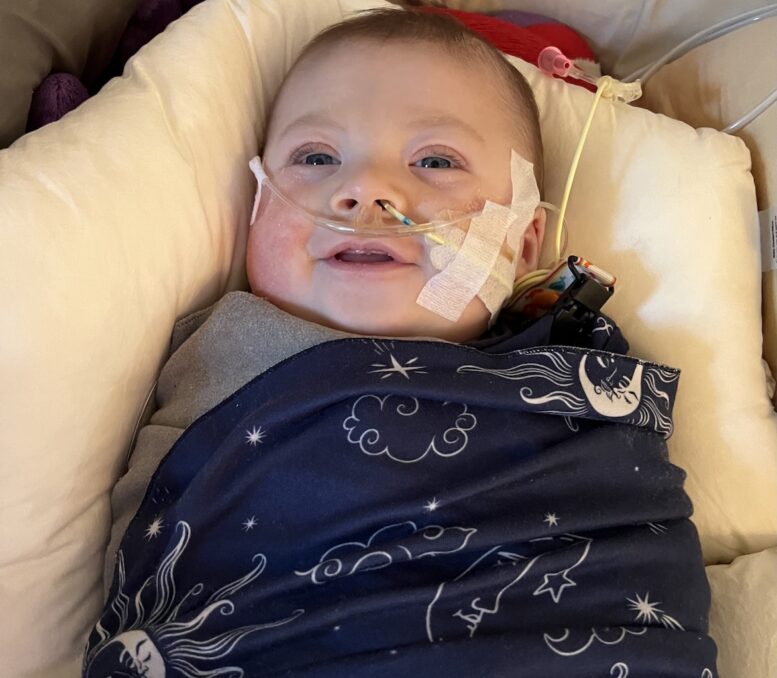
Lincoln remains dependent on oxygen and receives nutrition through an NG tube. He experiences sleep apnea and central apnea and can stop breathing during the night. His care involves numerous specialists, including neurology, nephrology, pulmonary medicine, ENT and sleep medicine.
His parents have also learned to pay close attention to the smallest signals.
Lincoln does not appear to have functional vision, but he can hear. When Alex or Justine speak, he seems to recognize their voices and turns his head toward their voices. He also responds to certain kinds of touch, such as having his head or feet rubbed, although other forms of touch can trigger spasms.
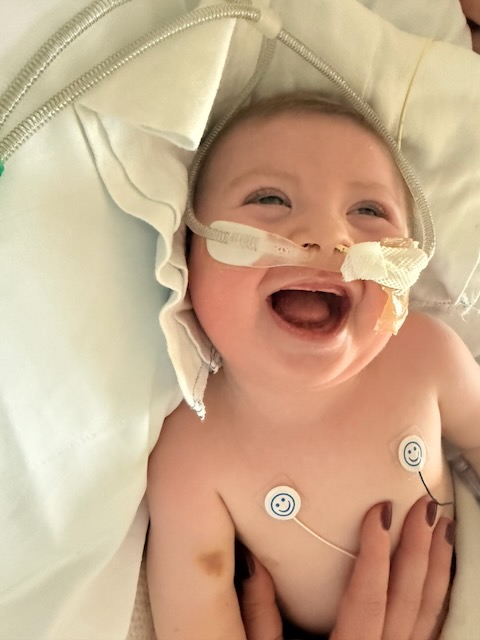
And sometimes, actually often, he smiles.
“He just smiles in his sleep,” Alex said. “It’s always in his sleep, so we don’t know what’s going on in there, but he’s smiling.”
Oh, how those moments matter, he said.
A family living in 24-hour shifts
While Lincoln’s medical needs consume much of the family’s time, the Wallaces are also raising two older children, Kellen and Jayden.
The boys, ages 10 and 8, are Alex’s stepsons, but he describes all three children simply as his family.
When Lincoln is hospitalized, Alex and Justine divide their lives into 24-hour shifts. One parent stays at the hospital while the other goes home to care for the boys, handle school, soccer, meals and everything else that does not stop simply because a child is sick.
Justine, a nurse, has also been able to work from home at times while caring for Lincoln.
The arrangement leaves little room for ordinary family life, Alex admitted. Extended relatives have stepped in with meals, overnight help, school pickups and other necessities.
Alex, who grew up in Bowling Green and whose ancestors are the namesake of Wallace Avenue, said that all the support they have received from family, friends and organizations has made an enormous difference.
The experience has also changed the family’s priorities.
“Little things like putting yard work over your kids really makes me like, ‘No, I’ve got to focus on them,’” he said. “Things can wait.”
Also for the family, time has become something measured differently.
Their lives are organized around hospital shifts, appointments, school schedules and the next medical need. Yet Alex said the family has learned to appreciate moments that might once have seemed insignificant.
Finding purpose beyond Lincoln’s diagnosis
Lincoln’s condition also changed Alex’s professional direction.
Alex had spent his career in sales. About a year before Lincoln’s diagnosis, a customer offered him a position with Supreme Creations, a company involved in charitable fundraising and sponsorships. At the time, he declined.
After Lincoln’s diagnosis, he reconsidered.
He eventually accepted the opportunity, turning his career toward helping organizations raise money for local charitable causes, such as Erie 5K-Race for the Kids, of which Lincoln is one of the Miracle Children.
Alex’s work connects businesses with fundraising efforts, allowing companies to purchase products such as printed shirts while a portion of the proceeds supports a designated charity. He’s been most appreciative of Roszman Roofing and Remodeling, Certainteed, and ABC Supply’s Findlay branch for their involvement with Supreme Creations.
For Alex, the work has become a way to turn an experience that cannot be changed into something that can help other people.
“That is now my new career path because of Lincoln,” he said.
The family is also helping raise awareness and support for organizations that assist families dealing with serious medical challenges.
Lincoln’s lessons
There are no easy answers in the Wallace family’s story.
There is the medical uncertainty. There are hospitalizations and specialists. There is the reality of a condition so rare that researchers struggle to secure funding to study it.
There is also the question every parent hopes never to face: How do you prepare for a future you cannot control?
For Alex and Justine, faith has become part of that answer.
The family is religious, and he said the belief that there is something beyond this life provides comfort.
But much of the family’s focus remains firmly in the present.
Lincoln may not be able to experience childhood in the way his parents imagined. He may never cognitively develop beyond infancy. But his parents continue to look for the things he can experience now: familiar voices, gentle touches, the presence of his brothers who love him dearly, and the comfort of being surrounded by people who matter.
When asked what a normal day would look like if Lincoln could have one, Alex’s answer was remarkably simple and filled with emotion.
“Just play,” he said. “Just play with him. Let him be a kid.”
That sentence captures the heart of the family’s journey.
They cannot change Lincoln’s diagnosis. They cannot make research funding appear or predict how long they will have with him. They cannot make the hospital stays disappear.
What they can do is make sure Lincoln knows the sound of their voices.
They can hold him.
They can rub his head.
They can let him smile.
And they can give him, as much as circumstances allow, the ordinary childhood every parent wants for their child.
For the entire family, that is what living with Lincoln’s diagnosis has ultimately become: not counting only the days ahead, but making the moments they have together matter.